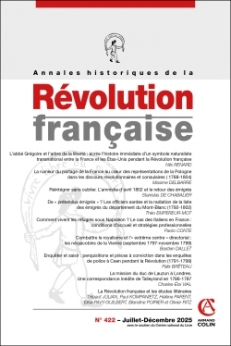
Annales historiques de la Révolution française Nº422 (4/2025)
Varia
Parution
décembre 2025
EAN
9782200935979
Prix au numéro
15 €
Marque
Armand Colin
Pagination
312 pages
Pour acheter ce numéro, contactez-nous
S'abonner
Recevez les numéros de l'année en cours et accédez à l'intégralité des articles en ligne.
Auteur(s)
Nils Renard
L’abbé Grégoire et l’arbre de la liberté : écrire l’histoire immédiate d’un symbole naturaliste transnational entre la France et les États-Unis pendant la Révolution française
Résumé
L’arbre de la liberté est un symbole politique essentiel de la Révolution franc¸aise. Associé à l’élan populaire spontané de la révolte, son articulation aux représentations officielles de la République conduit à une identification de ce symbole à la Révolution, d’abord américaine, puis franc¸aise, formant un symbole naturaliste révolutionnaire et transatlantique. En pleine guerre avec l’Angleterre et alors que les relations de la France républicaine avec les États-Unis se sont détériorées, Henri Grégoire publie son Essai historique et patriotique sur les arbres de la liberté, en germinal an II (avril 1794), texte qui, précisément, dresse des ponts avec l’usage du Tree of Liberty aux États-Unis et se clôt par une adresse au peuple anglais. Véritable traité sur la symbolique politique de l’arbre dans un régime républicain, le texte de Grégoire offre un espace de réflexion sur la diffusion des révolutions de part et d’autre de l’Atlantique. Nous nous attacherons à replacer ce texte et l’arbre de la liberté dans son contexte d’écriture, au plan politique mais aussi scientifique, et dans le dialogue avec les États-Unis et l’Angleterre qui y est esquissé, pour comprendre les enjeux de l’écriture d’une histoire immédiate de la Révolution sous les auspices de l’arbre de la liberté.
Mots clés
arbre de la liberté ; histoire naturelle ; transatlantique ; Henri Grégoire ; symbole
The Abbé Grégoire and The Liberty Tree. Writing the Immediate History of a Transnational Naturalistic Symbol between France and the United States during the French Revolution
Abstract
The liberty tree is an essential political symbol of the French Revolution. Associated with spontaneous popular uprising, its presence in official representations of the Republic soon became identified with the Revolutions, first the American, then the French, thus forming a naturalistic, revolutionary, and transatlantic symbol. Amid the war with England and at the time when relations between Republican France and the United States had deteriorated, Henri Grégoire published his Essai historique et patriotique sur les arbres de la liberté in Germinal Year II (April 1794), a text that specifically aimed to forge unity with the use of the liberty tree in the United States, concluding with an address to the English people. A veritable treatise on the political symbolism of the liberty tree in a republican regime, Grégoire’s text offers an occasion for reflections on the spread of revolutions on both sides of the Atlantic. This article focuses on placing this text and the theme of the liberty tree within the body of his writings, both political and scientific; the dialogue with the United States and England outlined in it helps illuminate the challenges of writing an immediate history of the Revolution, here under the auspices of the liberty tree.
Citation
Nils Renard, « L’abbé Grégoire et l’arbre de la liberté : écrire l’histoire immédiate d’un symbole naturaliste transnational entre la France et les États-Unis pendant la Révolution française », Annales historiques de la Révolution française Nº422 (4/2025), pp. 3-25, Armand Colin. Disponible sur : http://www.revues.armand-colin.com/histoire/annales-historiques-revolution-francaise/annales-historiques-revolution-francaise-no422-42025/labbe-gregoire-larbre-liberte-ecrire-lhistoire