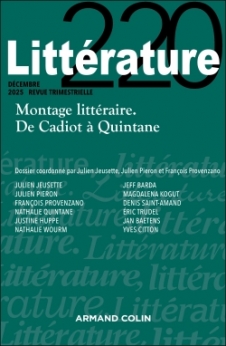
Littérature Nº220 (4/2025)
Montage littéraire. De Cadiot à Quintane
Parution
décembre 2025
EAN
9782200936235
Prix au numéro
18 €
Marque
Armand Colin
Pagination
150 pages
Pour acheter ce numéro, contactez-nous
S'abonner
Recevez les numéros de l'année en cours et accédez à l'intégralité des articles en ligne.
Auteur(s)
Justine Huppe
Des « militants du cut-up » ? Morales de la Revue de littérature générale
Résumé
Cet article examine les ambitions esthétiques, politiques et philosophiques de la Revue de littérature générale (RLG), fondée au milieu des années 1990 par Olivier Cadiot et Pierre Alferi. Loin de tout fétichisme du cut-up ou d’un simple héritage avant-gardiste, la revue se conçoit comme un « dépôt de techniques » valorisant le montage, l’échantillonnage et le recyclage textuel. En affinité avec certaines démarches du second Wittgenstein ou des objectivistes américains, elle privilégie l’exemplarité sur la théorisation, misant sur les usages concrets du langage. L’article analyse les enjeux politiques de cette posture : critique de l’inspiration individuelle, valorisation d’un artisanat littéraire, mise à disposition de méthodes plutôt que de manifestes. Trente ans après sa création, la RLG continue de susciter une réflexion sur la technicité du littéraire et ses implications collectives.
“Cut-up activists”? Morals of the Revue de littérature générale
Abstract
This article examines the aesthetic, political and philosophical ambitions of the Revue de littérature générale (RLG), founded in themid-1990s by Olivier Cadiot and Pierre Alferi. Far from channelling a blind devotion to cut-up or a simple legacy of the avant-garde genre, the publication was designed as a “repository of techniques”, showcasing montage, sampling and the recycling of textual material. Having an affinity with certain later Wittgenstein or American objectivist approaches, it focuses on exemplarity rather than theorisation, concentrating on specific uses of language. The article analyses the political ramifications of this stance : a critique of individual inspiration, spotlighting a literary craft, and offering methods rather than manifestos. Thirty years after its creation, the RLG continues to provide food for thought on literary technicality and its collective implications.
Citation
Justine Huppe, « Des « militants du cut-up » ? Morales de la Revue de littérature générale », Littérature Nº220 (4/2025), pp. 28-40, Armand Colin. Disponible sur : http://www.revues.armand-colin.com/lettres-langues/litterature/litterature-no220-42025/militants-du-cut-up-morales-revue-litterature-generale
DANS LA MÊME thématique

Auteur(s)
Daniel Lançon
ROMANTISME N°205 (3/2024)
Présences noires
Parution:
septembre 2024

Auteur(s)
Micaela Rossi Danio Maldussi Moreno La Quatra
LANGAGES N° 237 (1/2025)
Intelligence artificielle, corpus et diversité linguistique
Parution:
mars 2025