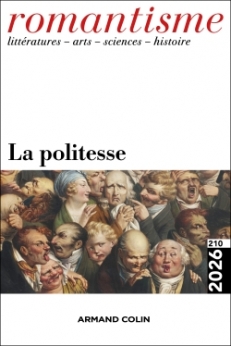
Romantisme N°210 (4/2025)
La politesse
Parution
décembre 2025
EAN
9782200936426
Prix au numéro
20 €
Marque
Armand Colin
Pagination
144 pages
Pour acheter ce numéro, contactez-nous
S'abonner
Recevez les numéros de l'année en cours et accédez à l'intégralité des articles en ligne.
Auteur(s)
Camille Trucart
Musset et la distinction nobiliaire : de l’urbanité à l’incivilité
Résumé
Dans ses comédies, proverbes dramatiques et nouvelles, Alfred de Musset met en scène une politesse ambivalente, transformée par les mutations sociales et culturelles du XIXe siècle. Héritier d’un idéal nobiliaire, il oppose le naturel raffiné de l’honnête homme de l’Ancien Régime à la civilité artificielle d’une bourgeoisie et d’une nouvelle aristocratie financière guidées par les manuels de savoir-vivre. Cette tension entre l’urbanité souple et instinctive et l’étiquette codifiée nourrit une réflexion sur la distinction, essentielle pour le vicomte et l’aristocrate de plume qu’il est. Avec un mélange d’adhésion et d’ironie, il envisage le dandysme comme un modèle de politesse dissident : en rompant délibérément avec les bons usages, le dandy réinvente une forme de civilité qui le distingue du vulgaire. Son rapport paradoxal à la politesse révèle ainsi les fractures d’une société en voie de démocratisation, où les signes extérieurs de politesse ne garantissent plus la légitimité sociale, ni l’élégance morale.
« Musset and aristocratic distinction : from decorum to discourtesy »
Abstract
In his comedies, proverbes dramatiques and novels, Alfred de Musset portrays an ambivalent politeness, transformed by the social and cultural changes of the 19th century. Born into the aristocratic ideal, he contrasts the innate refinement of an honest man under the Ancien Régime with the superficial courtesy of the bourgeoisie and new financial aristocracy, informed by etiquette guides. This clash between adaptable, instinctive manners and codified etiquette provides food for thought on the notion of distinction, a fundamental concept for the viscount and the aristocratic literary figure that he is. With a blend of adherence and irony, he sees dandyism as a kind of dissident politeness: by deliberately breaking with prevailing norms, the dandies reinvented courtesy in a way that set them apart from the common people. Their paradoxical relationship with politeness exposes the cracks in a society on the path to democracy, where an outward show of manners had ceased to ensure either social legitimacy or moral elegance.
Citation
Camille Trucart, « Musset et la distinction nobiliaire : de l’urbanité à l’incivilité », Romantisme N°210 (4/2025), pp. 30-40, Armand Colin. Disponible sur : http://www.revues.armand-colin.com/lettres-langues/romantisme/romantisme-ndeg210-42025/musset-distinction-nobiliaire-lurbanite-lincivilite
DANS LA MÊME thématique
Auteur(s)
Bertrand Guest
LITTÉRATURE Nº216 (4/2024)
Traduction et écologie
Parution:
décembre 2024

Auteur(s)
Sarah Al-Matary
ROMANTISME N°206 (4/2024)
Matières scolaires
Parution:
décembre 2024