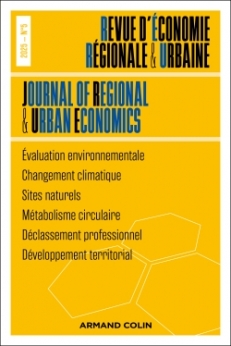
Revue d'économie régionale et urbaine (5/2025)
Varia
Parution
décembre 2025
EAN
9782200936327
Prix au numéro
18 €
Marque
Armand Colin
Pagination
184 pages
Pour acheter ce numéro, contactez-nous
S'abonner
Recevez les numéros de l'année en cours et accédez à l'intégralité des articles en ligne.
Auteur(s)
Jean-Marc Callois
Vers de nouveaux indicateurs du potentiel d’action collective pour le développement territorial
Résumé
Le développement territorial nécessite de coordonner efficacement des acteurs entretenant des relations de proximité. L’objectif de cette note de recherche est de proposer de nouveaux indicateurs permettant de caractériser la variabilité spatiale de la tendance à l’action collective. Trois types de phénomènes d’organisation sont distingués : la collaboration entre pairs, l’activation de complémentarités entre acteurs hétérogènes grâce à la confiance et la capacité à se coordonner en faveur du développement local. Pour chaque phénomène, deux types d’indicateurs sont proposés, un indicateur de « stock » et un indicateur de « flux ». La cartographie et les corrélations entre ces indicateurs suggèrent qu’ils constituent des outils prometteurs pour prédire la capacité pour les acteurs locaux à se saisir d’une démarche de développement territorial. Ces indicateurs illustrent aussi la diversité des phénomènes à prendre en compte pour évaluer le potentiel d’action collective sur un territoire.
Mots clés
Action collective
capital social
développement territorial
gouvernance territoriale
indicateurs
Towards new indicators of the potential for collective action for territorial development
Abstract
Territorial development implies co-ordinating efficiently heterogeneous actors linked by proximity relationships. The aim of this research note is to propose innovative indicators that allow the assessment of the tendency toward collective organisation, and its spatial variability. Three types of organisational phenomena are distinguished. First, collaboration between peers, which is linked to the inclination towards group activities. Second, interdependencies between heterogeneous actors, which is eased by the level of trust that prevails in the local society. Third, the capacity of coordination for local development projects, which is linked to the attachment to the territory. For the two first categories, indicators are computed at a local level, which is the “bassin de vie” (“living area”), a statistical unit grouping municipalities on the basis of home-to-work commuting and on the availability of basic services. Indicators are computed at regional level for the third category of organisational phenomena, due to availability constraints. For each phenomenon, two types of indicators are presented. First a “stock” indicator, i.e. the ratio of a countable entity per capita. Second, a “flux” indicator, i.e. an indicator based on the variation of a countable entity. All in all, six indicators are tested. Maps and correlation matrices suggest that they constitute promising tools for predicting the capacity for local actors to implement a territorial development approach efficiently. They also illustrate the diversity of phenomena that must be taken into account in order to understand the different aspects of territorial development. One direct application is the possibility of identifying areas where spontaneous collective action is highly prone to emerge, and conversely, where territorial development is conditioned by high efforts of co-ordination and contractualisation.
Keywords
Collective action
social capital
territorial development
territorial governance
indicators
Citation
Jean-Marc Callois, « Vers de nouveaux indicateurs du potentiel d’action collective pour le développement territorial », Revue d'économie régionale et urbaine (5/2025), pp. 899-914, Armand Colin. Disponible sur : http://www.revues.armand-colin.com/eco-sc-politique/revue-deconomie-regionale-urbaine/revue-deconomie-regionale-urbaine-52025/nouveaux-indicateurs-du-potentiel-daction-collective
DANS LA MÊME thématique

Auteur(s)
Maryline Filippi
REVUE D'ÉCONOMIE RÉGIONALE ET URBAINE (1/2024)
Varia
Parution:
février 2024
Auteur(s)
Maria Victoria Ramirez Munoz Francisco Rabadȧn Pérez María Cortés Ruiz
Revue d'économie régionale et urbaine (2/2026)
Parution:
avril 2026