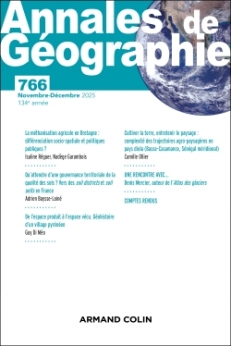
Annales de géographie - N°766 (6/2025)
Parution
décembre 2025
EAN
9782200935931
Prix au numéro
20 €
Marque
Armand Colin
Pagination
120 pages
S'abonner
Recevez les numéros de l'année en cours et accédez à l'intégralité des articles en ligne.
Auteur(s)
Guy Di Méo
De l’espace produit à l’espace vécu. Géohistoire d’un village pyrénéen
Résumé
Outils méthodologiques de la géographie sociale, les concepts d’espaces « conçu », « produit », « perçu » (espace de vie) et « vécu » sont mobilisés, ici, afin d’identifier, dans une optique géo-historique, les dynamiques socio-spatiales qui ont façonné un village pyrénéen : Sévignacq-Meyracq, commune béarnaise localisée à l’entrée de la vallée d’Ossau. Le modèle théorico-méthodologique de la « formation socio-spatiale » permet de saisir les rapports tissés, au fil du temps, entre la matérialité de ce territoire et le système symbolique, évolutif mais à forte inertie, qui a contribué à générer des représentations sociales partagées par ses habitants. Pour cerner son vécu de ce village et pour en mesurer la portée ontologique, l’auteur procède à l’introspection phénoménologique des lieux et des paysages. Au-delà du propos géographique, cette méthode pourrait ouvrir le chemin d’une approche novatrice de la démocratie locale et de la conquête du bien-être, par et pour des habitants/citoyens développant une nouvelle conscience de leur appartenance territoriale et de leurs responsabilités tant sociales qu’écologiques.
Mots clés
démocratie locale
espace produit
espace conçu
espace social
espace vécu
identité
lieu
Paysage
représentations sociales
territoire
From produced space to lived space. Geohistory of a village in the Pyrenees
Abstract
As methodological tools of social geography, the concepts of “designed”, “produced”, “perceived” (living space) and “lived” spaces are used here to identify the overall socio-spatial dynamics of a Pyrenean village, from a geo-historical perspective. The village in question is Sévignacq-Meyracq, located at the entrance to the Ossau Valley in Béarn. The theoretical-methodologicalmodel of “socio-spatial formation” provides insights into the relationships woven, over time, between the materiality of the territory and the symbolic system, evolving but with a high degree of inertia, which has helped to create the social representations shared by its inhabitants. The author used phenomenological introspection of places and landscapes to identify his own “lived space” in this village and to measure its ontological significance. Over and above its geographical significance, this methodology could pave the way for an innovative approach to local democracy and the achievement of well-being, by and for residents/citizens developing a new awareness of their territorial belonging and their social and ecological responsibilities.
Keywords
designed space
identity
Landscape
lived space
local democracy
place
produced space
social representations
social space
territory
Citation
Guy Di Méo, « De l’espace produit à l’espace vécu. Géohistoire d’un village pyrénéen », Annales de géographie - N°766 (6/2025), pp. 54-78, Armand Colin. Disponible sur : http://www.revues.armand-colin.com/geographie/annales-geographie/annales-geographie-ndeg766-62025/lespace-produit-lespace-vecu-geohistoire-dun-village-pyreneen
DANS LA MÊME thématique
Auteur(s)
Guy Chiasson Anne Mévellec
L'INFORMATION GÉOGRAPHIQUE (2-3/2025)
Diversité et égalité/Dimension spatiale et approche intersectionnelle des rapports sociaux
Parution:
septembre 2025
Auteur(s)
Sihé Neya
L'INFORMATION GÉOGRAPHIQUE (1/2025)
Géographies africaines ordinaires
Parution:
mars 2025