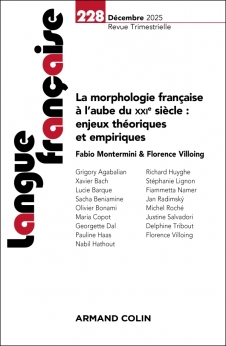
LANGUE FRANÇAISE Nº 228 (4/2025)
La morphologie française à l’aube du XXIe s. : enjeux théoriques et empiriques
Parution
décembre 2025
EAN
9782200936112
Prix au numéro
18 €
Marque
Armand Colin
Pagination
168 pages
Pour acheter ce numéro, contactez-nous
S'abonner
Recevez les numéros de l'année en cours et accédez à l'intégralité des articles en ligne.
Auteur(s)
Jan Radimský
Florence Villoing
Le rôle de trois familles semi-spécifiées dans le développement du modèle de composition ‹N-N› de type Attributif
Résumé
Cet article étudie l’origine et le développement diachronique des composés ‹Attributif-Appositif Nom+Nom› (N-N) en français, en se concentrant sur trois familles semi-schématiques : NMODÈLE, N-LIMITE et N-SURPRISE. En s’appuyant sur les données diachroniques du corpus GOOGLE BOOKS, l’étude examine l’émergence de ces composés et l’évolution de leur productivité depuis la fin du XIXe siècle jusqu’à nos jours. Les résultats mettent en évidence les « mots-leaders » qui ont marqué la formation de ces modèles et identifient les tendances significatives et les tournants dans la prolifération de ces trois familles de composés, qui ont joué un rôle crucial dans la formation du modèle plus large Attributif-Appositif (ATAP) en français. L’étude s’inscrit dans les cadres théoriques de Construction Morphology et de la Relational Morphology.
Mots clés
composés attributifs-appositifs ; composition française Nom+Nom ; diachronie ; morphologie des constructions ; morphologie relationnelle
The Role of Three Semi-Specified Families in the Development of the Attributive ‹N-N› Compounding Model
Abstract
This article investigates the origin and diachronic development of ‹Attributive-Appositive Noun+Noun› (N-N) compounds in French, focusing on three semi-schematic families: N-MODÈLE, N-LIMITE, and N-SURPRISE. Drawing on diachronic data from the GOOGLE BOOKS corpus, the study examines these compounds’ emergence and subsequent productivity evolution from the late 19th century to the present day. The findings highlight the key innovations (“leader words”) that marked the formation of these patterns and identify significant trends and turning points in the proliferation of these three families of compounds, which have played a crucial role in shaping the broader Attributive-Appositive (ATAP) pattern in French. The study is framed within Construction Morphology and Relational Morphology theories, offering insights into the interaction between lexical specificity and abstract constructional patterns.
Keywords
Attributive-Appositional Compounds ; French Noun+Noun Compounds ; Diachrony ; Relational Morphology
Citation
Jan Radimský, Florence Villoing, « Le rôle de trois familles semi-spécifiées dans le développement du modèle de composition ‹N-N› de type Attributif », LANGUE FRANÇAISE Nº 228 (4/2025), pp. 129-144, Armand Colin. Disponible sur : http://www.revues.armand-colin.com/lettres-langues/langue-francaise/langue-francaise-no-228-42025/role-trois-familles-semi-specifiees-developpement-du-modele-composition-n-n-type