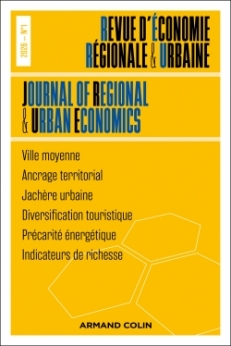
Revue d'économie régionale et urbaine (1/2026)
Parution
février 2026
EAN
9782200936907
Prix au numéro
18 €
Marque
Armand Colin
Pagination
168 pages
Pour acheter ce numéro, contactez-nous
S'abonner
Recevez les numéros de l'année en cours et accédez à l'intégralité des articles en ligne.
Auteur(s)
Chloé Desplechin
Louise Herry
Un mouvement pour d’autres indicateurs de richesse à l’échelle locale ? Émergence d’un champ de recherche hétérogène
Résumé
Alors que les territoires ont un rôle décisif à jouer pour la transition socio-écologique ainsi que pour l’amélioration de la qualité de vie des habitants, la transformation des indicateurs de richesse territoriaux apparaît nécessaire, et ces derniers connaissent une forte dynamique. Pour comprendre comment s’est structuré le champ de recherche sur les nouveaux indicateurs de richesse territoriaux, cet article présente une revue de littérature exploratoire (scoping review) à partir d’une recherche systématique de publications académiques en français. Cette étude permet de réaliser un état des lieux des connaissances académiques sur le champ, souligne la dynamique de publication sur ces indicateurs depuis les années 2000, ainsi que la grande hétérogénéité de ces initiatives tant du point de vue des concepts que des méthodologies.
Mots clés
nouveaux indicateurs de richesse
indicateurs alternatifs et complémentaires au pib
développement durable
bien-être
transformation socio-écologique des territoires
A movement for Beyond GDP indicators at the local level ? Emergence of a heterogeneous field of research
Abstract
The ecological and social emergency calls for an overhaul of the foundations of Economics, such as the concept of wealth, frequently reduced to economic growth. Integrating the issue of sustainability, in its essential interconnection with that of well-being and justice, means considering all facets of wealth. New indicators of wealth, or Beyond GDP indicators, aim to quantify concepts as varied as quality of life, sustainability, well-being, happiness, social and/or ecological health, human development, progress and resilience. Research is still needed on new indicators of wealth at the local level, particularly as this is one of the key levers in achieving a just socio-ecological transition. To understand how the field of research on new local indicators of wealth is structured, this article presents an exploratory literature review (scoping review) based on a search of academic papers in French. This review is based on the PRISMA-ScR protocol and explores a corpus of 97 references. Following early contributions by geographers in the 1980s, academic production on this topic intensified in the 2010s, when economists began to engage with it more directly. A mapping of the key concepts, definitions and methodologies encountered highlights the great heterogeneity of the field. This result shows that there is no unified French-speaking research movement on the subject of new indicators of wealth at the local level. The question of how these indicators are used is largely overlooked in most of the publications in the corpus or addressed only allusively through mentions of a few anticipated uses – often in the conclusions, in the form of public policy recommendations. This leaves open a field for further research.
Keywords
new indicators of wealth
beyond gdp indicators
sustainable development
well-being
socio-ecological transformation at a local level
Citation
Chloé Desplechin, Louise Herry, « Un mouvement pour d’autres indicateurs de richesse à l’échelle locale ? Émergence d’un champ de recherche hétérogène », Revue d'économie régionale et urbaine (1/2026), pp. 143-164, Armand Colin. Disponible sur : http://www.revues.armand-colin.com/eco-sc-politique/revue-deconomie-regionale-urbaine/revue-deconomie-regionale-urbaine-12026/mouvement-dautres-indicateurs-richesse-lechelle-locale
DANS LA MÊME thématique

Auteur(s)
Gwénaël Doré
REVUE D'ÉCONOMIE RÉGIONALE ET URBAINE (1/2024)
Varia
Parution:
février 2024