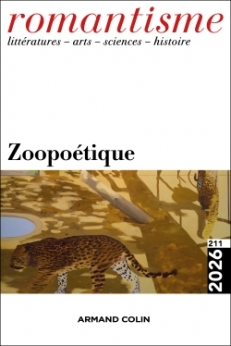
Romantisme N°211 (1/2026)
Parution
mars 2026
EAN
9782200937041
Prix au numéro
20 €
Marque
Armand Colin
Pagination
132 pages
Pour acheter ce numéro, contactez-nous
S'abonner
Recevez les numéros de l'année en cours et accédez à l'intégralité des articles en ligne.
Auteur(s)
Aimé Guex
Dans l’ombre du locus amoenus. Bestialité et désir animal dans la poétique de Musset, Mendès et Rachilde
Résumé
La culture de l’intimité et du privé réagence durant le XIXe siècle, en parallèle du paradigme évolutionniste, la représentation littéraire de la bestialité, comprise comme relation sexuelle entre un humain et un animal. Une approche chronologique et zoopoétique de Gamiani et des textes de Catulle Mendès et Rachilde met en relief l’émergence progressive d’un désir amoureux et érotique chez l’animal, censé en être dépourvu. Cette évolution influe esthétiquement sur une écriture empreinte de sensualité qui articule procédés sémantiques et modélisations. Au-delà de la dimension sulfureuse et scandaleuse souvent évoquée, la représentation de la bestialité possède des enjeux stylistiques et ouvre vers des investissements et innovations poétiques, qui confèrent aux bêtes une profonde agentivité.
« In the shadow of the locus amoenus. Bestiality and animal desire in the poetry of Musset, Mendès and Rachilde »
Abstract
During the 19th century, the culture of intimacy and privacy, alongside the evolutionary paradigm, altered the literary representation of bestiality, understood as sexual relations between a human and an animal. A chronological and zoopoetic approach to Gamiani and the texts of Catulle Mendès and Rachilde highlights the gradual emergence of romantic and erotic desire in animals, which were supposed to be devoid of such feelings. This evolution had an aesthetic influence on a style of writing imbued with sensuality, which articulated semantic processes and modelling. Beyond the scandalous and controversial dimension often evoked, the representation of bestiality has stylistic implications, and opens the way to poetic investments and innovations that confer profound agency on animals.
Citation
Aimé Guex, « Dans l’ombre du locus amoenus. Bestialité et désir animal dans la poétique de Musset, Mendès et Rachilde », Romantisme N°211 (1/2026), pp. 42-51, Armand Colin. Disponible sur : http://www.revues.armand-colin.com/lettres-langues/romantisme/romantisme-ndeg211-12026/lombre-du-locus-amoenus-bestialite-desir-animal-poetique-musset-mendes-rachilde
DANS LA MÊME thématique

Auteur(s)
Victoire Feuillebois
LITTÉRATURE Nº213 (1/2024)
Philosopher avec le romantisme français
Parution:
mars 2024