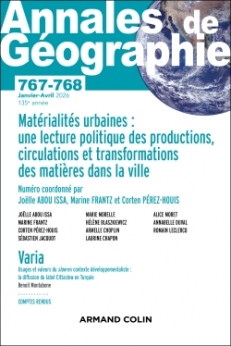
Annales de géographie - N°767-768 (1-2/2026)
Parution
avril 2026
EAN
9782200936556
Prix au numéro
40 €
Marque
Armand Colin
Pagination
192 pages
Pour acheter ce numéro, contactez-nous
S'abonner
Recevez les numéros de l'année en cours et accédez à l'intégralité des articles en ligne.
Auteur(s)
Romain Leclercq
Gouverner les eaux par l’infrastructure. Canalisation, infiltration et gestion des inondations à Dakar
Résumé
À partir d’une enquête sociologique sur les inondations régulières que connaît l’agglomération dakaroise depuis une trentaine d’années, ce texte revient sur l’histoire du gouvernement des eaux usées et de pluie dans la capitale sénégalaise. Il investigue particulièrement la manière dont la forme « canalisation » interagit avec d’autres formes de gouvernement des eaux, telles que l’infiltration, depuis les débuts de la colonisation. Revenant sur les entreprises récentes de construction d’une vaste infrastructure de drainage couvrant l’ensemble de la banlieue de Dakar et visant la lutte contre les inondations, il montre comment cette dernière articule idéal de l’infrastructure moderne et gestion distribuée des eaux. Ce faisant, il donne à voir, après d’autres, un processus hybride d’infrastructuration urbaine, et indique certaines de ses conséquences sur la production et le maintien d’une ville vulnérable aux inondations.
Mots clés
gouvernement
inondations
infrastructure
Ville
Vulnérabilité
Governing water through infrastructure. Canalisation, infiltration and flood management in Dakar
Abstract
Based on a study of the regular flooding that has occurred in Greater Dakar over the past thirty years, this paper looks back at the history of wastewater and rainwater management in the Senegalese capital. It examines the way in which the ‘sewer’form has interacted with other forms of water management, such as infiltration, since the early days of colonisation. Looking back at the recent construction of a vast drainage infrastructure covering the whole Dakar suburbs and designed to combat flooding, it shows how this infrastructure articulates the ideal of modern infrastructure and distributed water management. In so doing, it provides an example, following others, of a hybrid process of urban infrastructure development, and indicates some of its consequences for the production and maintenance of a city vulnerable to flooding.
Keywords
government
floods
infrastructure
City
Vulnerability
Citation
Romain Leclercq, « Gouverner les eaux par l’infrastructure. Canalisation, infiltration et gestion des inondations à Dakar », Annales de géographie - N°767-768 (1-2/2026), pp. 140-163, Armand Colin. Disponible sur : http://www.revues.armand-colin.com/geographie/annales-geographie/annales-geographie-ndeg767-768-1-22026/gouverner-eaux-linfrastructure-canalisation-infiltration-gestion-inondations
DANS LA MÊME thématique
Auteur(s)
Louka Herse
Annales de géographie - N°769 (3/2026)
Varia
Parution:
juin 2026

Auteur(s)
Cynthia Ghorra-Gobin
L'INFORMATION GÉOGRAPHIQUE (4/2024)
Varia : Eau, Méditerranée
Parution:
décembre 2024