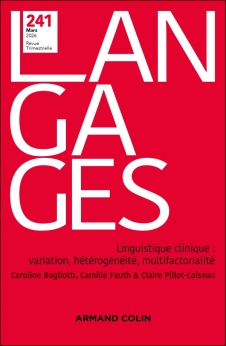
Langages Nº 241 (1/2026)
Linguistique clinique : variation, hétérogénéité, multifactorialité
Parution
avril 2026
EAN
9782200936686
Prix au numéro
18 €
Marque
Armand Colin
Pagination
150 pages
Pour acheter ce numéro, contactez-nous
S'abonner
Recevez les numéros de l'année en cours et accédez à l'intégralité des articles en ligne.
Auteur(s)
Anne-Claire Filippi
Solenne Dejouy
Claire Pillot-Loiseau
Fréquence intrinsèque vocalique chez des chanteuses et dysphoniques : contextes phonétiques et modalités
Résumé
La fréquence fondamentale intrinsèque Ifo est étudiée en français en parole, déclamation et chant chez des femmes normophoniques, dysphoniques et chanteuses. Moins importante que dans la littérature, elle est maximale pour /u/, puis /i/ et /o/, mais négative pour /ɛ/ et /ɛ/̃ en parole et déclamation pour les normophoniques. Elle est plus élevée en contact avec des consonnes non voisées, et moins élevée pour le chant et les chanteuses. Les dysphoniques montrent des données plus variables en déclamation, et plus contrastées entre les voyelles de Ifo maximale (/u/) et minimale (/ɛ/̃ ) en parole et chant, suggérant une variabilité adaptative dans la production de ces voyelles. Il en résulte une adaptation du protocole phonétique utile en rééducation vocale.
Mots clés
fréquence intrinsèque ; voix ; voyelles ; dysphonie ; chanteur
Intrinsic Vowel Pitch in Singers and Dysphonic Subjects : Phonetic Context and Tasks
Abstract
The intrinsic fundamental frequency Ifo was studied in French for spoken voice, declamation and singing in female without and with voice disorders, and singers. Less important than in the literature, it is maximal for /u/, then /i/ and /o/ but negative for /ɛ/ and /ɛ/̃ in speech and declamation for female without voice disorders. It is higher for vowels in contact with unvoiced consonants, and lower for singing and female singers. Subjects with voice disorders showed more variable data in declaimed speech, and more contrast between vowels of maximal (/u/) and minimal (/ɛ/̃ ) Ifo in speech and singing, suggesting adaptive variability in the production of these vowels. The result is an adaptation of the phonetic protocol useful in vocal rehabilitation.
Keywords
Intrinsic Frequency ; Voice ; Vowels ; Voice Disorder ; Singer
Citation
Anne-Claire Filippi, Solenne Dejouy, Claire Pillot-Loiseau, « Fréquence intrinsèque vocalique chez des chanteuses et dysphoniques : contextes phonétiques et modalités », Langages Nº 241 (1/2026), pp. 127-143, Armand Colin. Disponible sur : http://www.revues.armand-colin.com/lettres-langues/langages/langages-no-241-12026/frequence-intrinseque-vocalique-chanteuses-dysphoniques-contextes-phonetiques-modalites