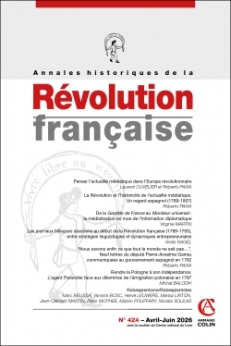
Annales historiques de la Révolution française Nº424 (2/2026)
Varia
Parution
juin 2026
EAN
9782200936594
Prix au numéro
15 €
Marque
Armand Colin
Pagination
280 pages
Pour acheter ce numéro, contactez-nous
S'abonner
Recevez les numéros de l'année en cours et accédez à l'intégralité des articles en ligne.
Auteur(s)
Michał Balogh
Rendre la Pologne à son indépendance. L’agent Parandier face aux dilemmes de l’émigration polonaise en 1797
Résumé
Après la signature du traité de Bâle et le troisième partage de la Pologne, l’ordre politique subit une transformation significative. Le gouvernement franc¸ais et les Polonais sont confrontés à des dilemmes concernant la signification et le rôle de leurs nations respectives en Europe. Le changement de pouvoir impérial à Saint- Pétersbourg (novembre 1796) et la signature du traité de Leoben (avril 1797) ont relancé le débat sur les alliances européennes : avec qui fallait-il s’allier ? Cette question était cruciale tant du point de vue polonais que franc¸ais. Cet article s’appuie principalement sur la correspondance de Parandier, un agent expérimenté de la République. En collaboration avec des émigrés polonais, il a élaboré une proposition visant à défendre la cause de l’État partitionné dans le cadre de la politique étrangère franc¸aise. Les réflexions présentées ici attirent non seulement l’attention sur le rôle exceptionnel de Parandier, mais illustrent également le processus de formation de la pensée politique. Elles inscrivent la question polonaise dans un contexte européen plus large.
Mots clés
Pologne ; traité de Leoben ; émigration ; agent politique ; République
Restoring Poland’s Independence. The Agent Parandier Faces the Dilemmas of Polish Emigration in 1797
Abstract
After the signing of the Treaty of Basel and the Third Partition of Poland, the European political order underwent a significant transformation. The French government and the Poles faced dilemmas about the significance and role of their respective nations in Europe. The change of imperial power in Saint Petersburg (November 1796) and the signing of the Treaty of Leoben (April 1797) revived the debate over European alliances: with which countries should other countries seek to ally themselves? This question was crucial from both the Polish and French point of view. This article is based mainly on the correspondence of Parandier, an experienced agent of the Republic. In collaboration with Polish émigrés, he developed a proposal aimed at defending the cause of the partitioned state within the framework of French foreign policy. The reflections presented here not only draw attention to Parandier’s exceptional role, but also illustrate the formation of political thought. And they place the Polish question in the larger European context.
Citation
Michał Balogh, « Rendre la Pologne à son indépendance. L’agent Parandier face aux dilemmes de l’émigration polonaise en 1797 », Annales historiques de la Révolution française Nº424 (2/2026), pp. 121-142, Armand Colin. Disponible sur : http://www.revues.armand-colin.com/histoire/annales-historiques-revolution-francaise/annales-historiques-revolution-francaise-no424-22026/rendre-pologne-son-independance-lagent