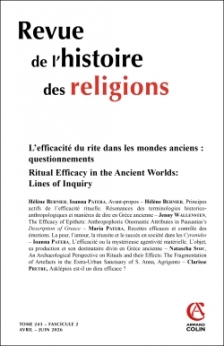
Revue de l'histoire des religions (2/2026)
L'efficacité du rite dans les mondes anciens : questionnements
Parution
juin 2026
EAN
9782200936877
Prix au numéro
18 €
Marque
Armand Colin
Pagination
168 pages
Pour acheter ce numéro, contactez-nous
S'abonner
Recevez les numéros de l'année en cours et accédez à l'intégralité des articles en ligne.
Auteur(s)
Hélène Bernier
Principes actifs de l’efficacité rituelle Résonances des terminologies historico-anthropologiques et manières de dire en Grèce ancienne
Résumé
En faisant dialoguer les notions de l’anthropologie culturelle exprimant les moteurs de l’efficacité rituelle et leurs usages par les historiens du monde grec, il appert que les notions de performativité, de mana ou d’efficacité psychologique demeurent formulées d’un point de vue moderne et généralisant et ne répondent pas à la question de savoir comment fonctionnent vraiment les rites, pour reprendre les termes d’une question récemment soulevée par les ritual studies. La question de l’efficacité posée en regard de quelques rites et textes grecs de l’époque classique et archaïque montre d’autres moteurs, et notamment la mise en avant de dispositifs convoquant l’altérité et la rupture d’avec le cours normal de l’existence, qui expriment du rituel un moyen d’action particulier.
Active Principles of Ritual Efficacy : Resonances between Anthropological-Historical Teminologies and Ways of Speaking in Ancient Greece
Abstract
From establishing a comparison between, on the one hand, the concepts of cultural anthropology that express the principles of ritual efficacy, and, on the other hand, the uses of those concepts by Ancient Greek historians, it appears that the particular concepts of performativity, mana, and psychological efficacy are formulated from a modern and generalising point of view, and do not answer the question of how rites really work – a question that has recently attracted attention in the field of ritual studies. In this article, the question of efficacy is considered in relation to a number of Greek rites and texts from across the classical and archaic periods. This analysis reveals other principles, and particularly the significance of processes capable of establishing a relationship of alterity with the world of everyday experience. This principle contributes to making ritual into a distinct mode of action.
Citation
Hélène Bernier, « Principes actifs de l’efficacité rituelle Résonances des terminologies historico-anthropologiques et manières de dire en Grèce ancienne », Revue de l'histoire des religions (2/2026), pp. 175-205, Armand Colin. Disponible sur : http://www.revues.armand-colin.com/histoire/revue-lhistoire-religions/revue-lhistoire-religions-22026/principes-actifs-lefficacite-rituelle-resonances-terminologies-historico
DANS LA MÊME thématique
Auteur(s)
Dominique Godineau
ANNALES HISTORIQUES DE LA RÉVOLUTION FRANÇAISE Nº417 (3/2024)
Travail et politique, 1789-1815
Parution:
septembre 2024
Auteur(s)
Guillaume Debat
ANNALES HISTORIQUES DE LA RÉVOLUTION FRANÇAISE Nº415 (1/2024)
Émotions révolutionaires
Parution:
mars 2024