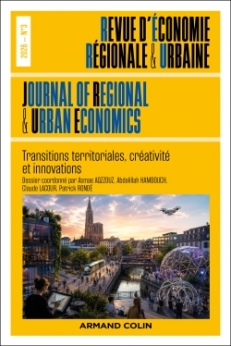
Revue d'économie régionale et urbaine (3/2026)
Transitions territoriale, créativité et innovations
Parution
juin 2026
EAN
9782200936921
Prix au numéro
18 €
Marque
Armand Colin
Pagination
224 pages
Pour acheter ce numéro, contactez-nous
S'abonner
Recevez les numéros de l'année en cours et accédez à l'intégralité des articles en ligne.
Auteur(s)
Dorian Maillard
Soixante-dix ans de politiques de relance du Bassin minier du Nord-Pas-de-Calais : les leçons de la reconversion sans fin d’un territoire en déclin
Résumé
L’accompagnement public de la transition post-minière du Bassin minier du Nord-Pas-de-Calais a fêté l’année dernière ses 70 ans. Son bilan reste cependant mitigé au vu des situations de vulnérabilité qui y sont toujours observables. La multiplication actuelle des projets de décarbonation dessine cependant l’espoir de voir se dessiner une nouvelle perspective de relance pour le territoire. Cet article se propose d’examiner cela à l’aune des trois précédents modèles de relance qui y furent conduits. La mise en résonance de leur « fabrique » contextuelle permet d’identifier la prégnance d’un paramétrage, politique et opérationnel, systémique du processus de reconversion post-minière du territoire. L’induration de ce paradigme d’action publique explique l’anachorisme opérationnel des politiques de (re)développement qui y sont conduites et interroge la capacité actuelle des acteurs du Bassin minier du Nord-Pas-de-Calais à concilier les enjeux de transitions, territoriale et écologique, pour sortir le territoire de sa reconversion sans fin.
Mots clés
anachorisme opérationnel
bassin minier du Nord-Pas-de-Calais
décarbonation
reconversion sans fin
territoire en déclin
Seventy Years of Relaunch Policies in the Bassin Minier du Nord-Pas-de-Calais : Lessons from the Never-Ending Reconversion of a Declining Territory
Abstract
Public support for the post-mining reconversion of the Bassin minier du Nord-Pas-de-Calais reached its 70th anniversary last year, marking a significant milestone in one of Europe’s longest-running territorial reconversion processes. Despite decades of sustained public intervention, the overall assessment of this process remains mixed, as this territory continues to show structural urban decline dynamics. These enduring challenges highlight the limits of past redevelopment strategies and call into question the long-term effectiveness of the way the reconversion process of this territory is conceived. At the same time, the recent proliferation of decarbonization initiatives— among which the development of the French electric vehicle ecosystem— brings hope for a new epoch of redevelopment for the territory. However, whether these initiatives can genuinely transform the region (bifurcation) or merely reproduce earlier patterns (path-dependence) remains an open question. This article addresses this issue by examining the three previous “modèles de relance” implemented in the area. By resonating their contextual "fabric", it highlights the persistence of a stable political framework and a largely unchanged operational logic underpinning post-mining reconversion policies. In particular, it shows how successive strategies have contributed to the formation of an unquestioned paradigm of public action, within the Bassin minier, which results in the systematic importation of public policy approaches that are ill-adapted to the territory’s specific challenges (operational anachorism). This mismatch helps explain the limited effectiveness of redevelopment efforts and raises critical questions about the capacity of public actors to articulate, in the coming years, territorial and ecological transitions in a coherent and place-sensitive manner. Ultimately, it suggests that overcoming the region’s “endless reconversion” will require a profound rethinking of the underlying frameworks guiding public intervention.
Keywords
operational anachorism
bassin minier du Nord-Pas-de-Calais
decarbonization
endless reconversion
left-behind places
Citation
Dorian Maillard, « Soixante-dix ans de politiques de relance du Bassin minier du Nord-Pas-de-Calais : les leçons de la reconversion sans fin d’un territoire en déclin », Revue d'économie régionale et urbaine (3/2026), pp. 329-348, Armand Colin. Disponible sur : http://www.revues.armand-colin.com/eco-sc-politique/revue-deconomie-regionale-urbaine/revue-deconomie-regionale-urbaine-32026/soixante-dix-ans-politiques-relance-du-bassin-minier-du