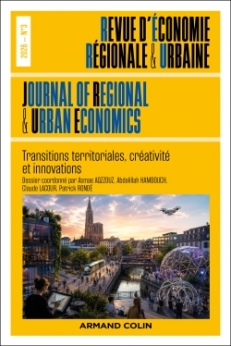
Revue d'économie régionale et urbaine (3/2026)
Transitions territoriale, créativité et innovations
Parution
juin 2026
EAN
9782200936921
Prix au numéro
18 €
Marque
Armand Colin
Pagination
224 pages
Pour acheter ce numéro, contactez-nous
S'abonner
Recevez les numéros de l'année en cours et accédez à l'intégralité des articles en ligne.
Auteur(s)
Valentin Russeil
Hélène David-Benz
Claire Cerdan
Frédéric Wallet
Margaux Nolet
Louis Olié
Quels chemins de transition vers une autonomisation et agroécologisation des systèmes alimentaires ?
Résumé
Sur l’île de La Réunion, département insulaire français d’outremer, nous étudions la possibilité d’une synergie entre autonomisation et écologisation dans le cadre d’une transition du système alimentaire (« Transition Écologisation-Autonomisation » ou TECAU). Nous avons conduit entretiens et questionnaires auprès d’acteurs « têtes de réseau » afin de faire émerger les principales postures autour de controverses relatives à la TECAU, et nous avons traduit ces postures en chemins de transition contrastés promus par les acteurs locaux. Parallèlement, nous avons complété la description de chaque chemin en caractérisant des initiatives de transition perçues comme positives. Nous identifions ainsi trois chemins de transition qui décrivent un ajustement progressif ou au contraire une transformation plus radicale du système alimentaire réunionnais. Ils sont caractérisés par différents degrés de modifications structurelles du système, d’exigences environnementales et d’interventions publiques. Enfin, nous discutons comment ces chemins contribuent à l’autonomisation et l’écologisation, en pointant leurs atouts, limites et les freins économiques et institutionnels à lever.
Mots clés
autonomie alimentaire
agroécologie
chemins de transition
controverses du système alimentaire
La Réunion
Which pathways for transitioning towards self-sufficient and agroecological food systems ?
Abstract
On Reunion Island, a French overseas department, we study a potential synergy between a rise of food self-sufficiency and ecology at the scale of a food system transition (“Ecologization-Autonomization Transition” or ECAUT). To do so, we developed a method to identify and characterize different possible transition pathways. Firstly, we conducted semi-structured interviews with “network leaders”, coupled with questionnaires, to reveal ECAUT controversies and quantify how local stakeholders position themselves regarding these issues. Secondly, we studied some initiatives perceived as positive by each transition pathway’s promoters. Thirdly, by combining statistical clustering with discourse analysis, three transition paths were identified and described, ranging from an incremental adjustment to a more radical transformation. They are characterized by different degrees of structural modifications of the system, environmental requirements, and public interventions. The first one considers that transition requires to go further in the structuring of agri-food chains, to create economic value, employment and guarantee market share for some fresh and processed products, preserving a sugar cane ‘pivot’. The second one considers that policies must play a major role, supporting all types and sizes of farms to switch progressively towards agroecology and organic farming. The third one sees transition as a more radical process, which includes an agro-ecological, societal, planned and decentralized transformation of all the food system. Finally, we discuss how identified transition pathways can contribute to food self-sufficiency and ecology at food system scale, especially by pointing out their main assets and drawbacks, along with some economic and institutional lock-ins to be overcome.
Keywords
agroecology
food system controversies
food self-sufficiency
transition pathways
Reunion Island
Citation
Valentin Russeil, Hélène David-Benz, Claire Cerdan, Frédéric Wallet, Margaux Nolet, Louis Olié, « Quels chemins de transition vers une autonomisation et agroécologisation des systèmes alimentaires ? », Revue d'économie régionale et urbaine (3/2026), pp. 349-379, Armand Colin. Disponible sur : http://www.revues.armand-colin.com/eco-sc-politique/revue-deconomie-regionale-urbaine/revue-deconomie-regionale-urbaine-32026/quels-chemins-transition-autonomisation-agroecologisation
DANS LA MÊME thématique
Auteur(s)
Maëlle Nicault Priscilla Thébaux Julien Lallemand
REVUE D'ÉCONOMIE RÉGIONALE ET URBAINE (2/2025)
Les territoires périphériques et ultrapériphériques face aux crises majeures
Parution:
avril 2025