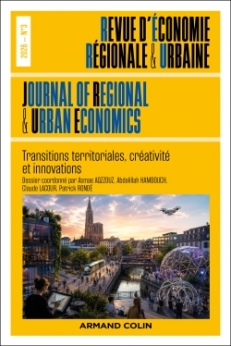
Revue d'économie régionale et urbaine (3/2026)
Transitions territoriale, créativité et innovations
Parution
juin 2026
EAN
9782200936921
Prix au numéro
18 €
Marque
Armand Colin
Pagination
224 pages
Pour acheter ce numéro, contactez-nous
S'abonner
Recevez les numéros de l'année en cours et accédez à l'intégralité des articles en ligne.
Auteur(s)
Stéphanie Truchet-Aznar
Chloé Duvivier
Jacques Veslot
Impact de la gratuité sur la fréquentation des transports en commun. Le cas de Clermont Auvergne Métropole
Résumé
En France comme à l’étranger, les collectivités territoriales recourent de manière croissante à la gratuité des transports en commun pour répondre à des objectifs sociaux et/ou environnementaux. Or, peu de travaux scientifiques évaluent les effets réels de cette mesure. Nous évaluons l’impact de la gratuité des transports en commun le week-end, mise en place en 2021 par Clermont Auvergne Métropole, sur leur fréquentation. Pour cela, nous utilisons un modèle économétrique basé sur une comparaison de la fréquentation avant et après la mise en place de la mesure et contrôlons l’effet des principaux déterminants de la demande de transport en commun. Nos résultats montrent que, sur les lignes et arrêts observés, la gratuité a entrainé une hausse de 47 % de la fréquentation le week-end. Nos résultats indiquent également que l’effet de la gratuité est plus élevé pour le tramway que pour les lignes de bus.
Mots clés
gratuité des transports en commun
mobilité des ménages
politiques de transport
transition des territoires
The Impact of Fare-Free Public Transport on Ridership : Evidence from Clermont Auvergne Métropole
Abstract
In a world increasingly shaped by climate change and, more broadly, by environmental issues, transport and household mobility play a central role in territorial transition. Given these challenges, local authorities in France and other countries are increasingly implementing fare-free public transport to encouragemodal shift (environmental objective) but also to improvemobility for themost disadvantaged populations (social objective). However, little scientific research has been conducted to assess the true impacts of this policy. This paper analyses the impact of fare-free public transport at weekends introduced in December 2021 by Clermont Auvergne Metropole. Using an econometric model, we compare public transport ridership before and after the policy’s implementation, focusing on the same transport lines, directions, bus stops, time period, and weekend days (Saturday or Sunday). Ridership estimates are based on ticket validation data before the policy and manual counts afterwards. In order to isolate the effect of fare-free public transport, we introduce control variables for key determinants of public transport ridership (e.g., public transport supply, fuel prices, weather data). Given the evaluation period, we also account for potential impacts of the COVID-19 crisis on household mobility. Our results show that fare-free public transport has led to a 47% increase in weekend ridership on the observed routes and stops. We also find that the effect is similar on Saturdays and Sundays, but more pronounced on the tramway line than on the bus lines. To our knowledge, this study is the first econometric analysis of the effect of fare-free public transport in a French city.
Keywords
free public transport
household mobility
territorial transition
transport policies
Citation
Stéphanie Truchet-Aznar, Chloé Duvivier, Jacques Veslot, « Impact de la gratuité sur la fréquentation des transports en commun. Le cas de Clermont Auvergne Métropole », Revue d'économie régionale et urbaine (3/2026), pp. 407-435, Armand Colin. Disponible sur : http://www.revues.armand-colin.com/eco-sc-politique/revue-deconomie-regionale-urbaine/revue-deconomie-regionale-urbaine-32026/impact-gratuite-frequentation-transports-commun-cas