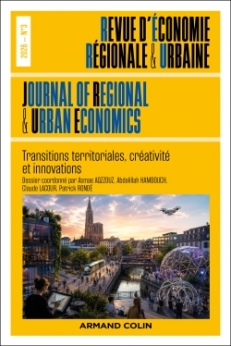
Revue d'économie régionale et urbaine (3/2026)
Transitions territoriale, créativité et innovations
Parution
juin 2026
EAN
9782200936921
Prix au numéro
18 €
Marque
Armand Colin
Pagination
224 pages
Pour acheter ce numéro, contactez-nous
S'abonner
Recevez les numéros de l'année en cours et accédez à l'intégralité des articles en ligne.
Auteur(s)
David Doloreux
Richard Shearmur
Zoé Catel
Patrick Chevarie
Les zones d’innovation au Québec : attributs et diversité des configurations régionales
Résumé
Les zones d’innovation se sont imposées comme un nouveau cadre d’intervention politique prisé par le gouvernement du Québec pour stimuler l’entrepreneuriat et l’innovation régionale. Cet article cherche à comprendre quels sont les éléments constitutifs d’une zone d’innovation et dans quelles mesures les configurations régionales dans lesquelles s’inscrivent ces zones influencent leur émergence et fonctionnement. L’analyse empirique est illustrée à partir d’études de cas portant sur les zones d’innovation Technum (Bromont), Distriq (Sherbrooke), Espace Aéro (région métropolitaine de Montréal) et Vallée de la transition énergétique (Mauricie et Centre-du-Québec), lesquelles mettent en lumière une diversité de configurations possibles.
Mots clés
Zones d'innovation
régions
Politiques régionales
Province du Québec
Innovation zones in Quebec : attributes and diversity of regional configurations
Abstract
Innovation zones (IZ) have emerged as a new policy framework favored by the Government of Quebec. The IZ is a place-based policy and it aligns with the basic premise that innovation emerges from dynamic and collaborative environments supported by proximity advantages and localized externalities. According to the Government of Quebec, an IZ is defined as a ‘geographically defined areas (contiguous sites located within a single municipality or across several neighboring municipalities) where actors from research, innovation, industry, and entrepreneurship are clustered and collaborate to foster a culture of innovation, while highlighting the sustainable competitive advantages of these territories or regions’. However, as a relatively new policy initiative, the IZs remain underdeveloped, which can hinder analyses of their structure and their role in supporting regional economic development. This article seeks to address these gaps by exploring the specific attributes of IZs and the regional configurations underpinning their emergence and functioning. First, we examine how IZs differ from regional innovation systems and clusters. To serve as a relevant policy framework, IZs must be more than a mere “branding strategy tool” that designates regions where diverse actors collaborate to foster a local culture of innovation. Rather, the concept of IZ should focus on their constitutive elements and networks, and on how the configuration of these elements enables the zone to develop. Second, we investigate the designated IZs in Quebec and analyze their regional configuration. The empirical analysis is illustrated through case studies of the Technum (Bromont), Distriq (Sherbrooke), Espace Aéro (Montréal region), and Vallée de la Transition Énergétique (Mauricie et Centre-du-Québec). These cases highlight the diversity of possible configurations and geographic contexts that characterize IZs. Third, we draw broader lessons relating to the specific policies associated with IZs.
Keywords
Innovation zone
regions
Regional policies
Province of Quebec
Citation
David Doloreux, Richard Shearmur, Zoé Catel, Patrick Chevarie, « Les zones d’innovation au Québec : attributs et diversité des configurations régionales », Revue d'économie régionale et urbaine (3/2026), pp. 479-500, Armand Colin. Disponible sur : http://www.revues.armand-colin.com/eco-sc-politique/revue-deconomie-regionale-urbaine/revue-deconomie-regionale-urbaine-32026/zones-dinnovation-au-quebec-attributs-diversite