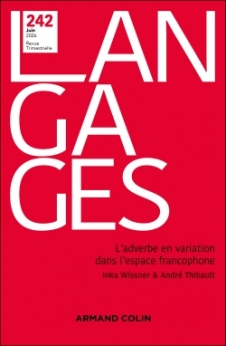
Langages Nº 242 (2/2026)
L'adverbe en variation dans l'espace francophone
Parution
juin 2026
EAN
9782200936693
Prix au numéro
18 €
Marque
Armand Colin
Pagination
162 pages
Pour acheter ce numéro, contactez-nous
S'abonner
Recevez les numéros de l'année en cours et accédez à l'intégralité des articles en ligne.
Auteur(s)
Myriam Bergeron-Maguire
L’adjectif adverbal solide en francophonie canadienne : histoire et gamme d’emplois
Résumé
L’adjectif adverbal solide est polysémique et se présente dans une large gamme d’emplois syntaxiques au Québec et en Acadie. Cette distribution en fait un diatopisme pancanadien. Cet article entend décrire l’emploi adverbial récent de solide en français canadien (1re attestation 1974, mais fréquent depuis 1990) en micro-diachronie. Il s’appuie sur des données orales. L’hypothèse défendue est que l’origine de l’emploi adverbial de solide diffère dans ces deux variétés. Au Québec, il a été obtenu à partir de contextes « métanalytiques » (Corminboeuf 2023) ouvrant la voie à un changement de catégorie grammaticale. En Acadie, il est dû au contact avec l’anglais nord-américain, où le Type A « monocatégoriel » (Hummel & Kröll, 2015 : 41) est fréquent. Cette influence a parfois été évoquée (Neumann-Holzschuh & Mitko, 2019 : 265), sans avoir jamais fait l’objet d’une démonstration.
Mots clés
diatopisme ; adverbe ; français québécois ; français acadien ; français parlé
The Adverbal Adjective Solide in Canadian French : History and Contextual Distribution
Abstract
The adverbal adjective solide is polysemous and occurs in a wide range of syntactic uses in Quebec and Acadia. This distribution makes it a pan-Canadian diatopism. This article aims to describe the recent adverbial use of solide in Canadian French (first attested in 1974, but frequent since 1990) from a micro-diachronic perspective. It is based on oral data drawn from existing corpora of Quebec and Acadian French. We argue that the origin of the adverbial use of solide differs in these two varieties. In the province of Quebec, it emerged from ‘metanalytic’ contexts (Corminboeuf 2023), paving the way for a change in grammatical category. In Acadia, it is attributed to contact with North American English, where the ‘monocategorial’ type A (Hummel & Kröll, 2015:41) is frequent. This influence has been mentioned before (Neumann- Holzschuh & Mitko, 2019:265) but has never been formally demonstrated.
Keywords
Diatopism ; Adverb ; Quebec French ; Acadian French ; Spoken French
Citation
Myriam Bergeron-Maguire, « L’adjectif adverbal solide en francophonie canadienne : histoire et gamme d’emplois », Langages Nº 242 (2/2026), pp. 59-74, Armand Colin. Disponible sur : http://www.revues.armand-colin.com/lettres-langues/langages/langages-no-242-22026/ladjectif-adverbal-solide-francophonie-canadienne-histoire-gamme-demplois