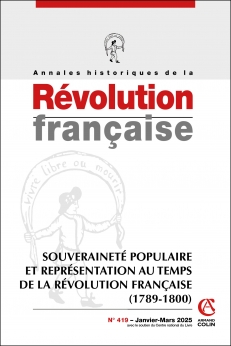
ANNALES HISTORIQUES DE LA RÉVOLUTION FRANÇAISE Nº419 (1/2025)
Souveraineté populaire et représentation au temps de la Révolution française (1789-1800)
Parution
mars 2025
EAN
9782200935948
Prix au numéro
15 €
Marque
Armand Colin
Pagination
216 pages
Pour acheter ce numéro, contactez-nous
S'abonner
Recevez les numéros de l'année en cours et accédez à l'intégralité des articles en ligne.
Auteur(s)
Anne Verjus
Are women’s interests and men’s interests convergent in national sovereignty ? On several discourses regarding the representation of women “as such”
Abstract
In the French context of family-based or familialist1 electoral laws and a doctrine of political representation that prohibits any notion of intermediate or particular interests, what is the status of alternative proposals that defend the necessity of representing women as such? By “representation of women as such”, we refer to the challenge to the universalist doctrine, regardless of how it was interpreted and applied at the time; either by advocates of women’s right to vote as undifferentiated individuals, such as Condorcet and Guyomar, or by electoral laws establishing the capacity of the paterfamilias alone to speak on behalf of the entire nation. The objective here is to examine the rare alternatives expressed in favor of voting rights for women “as women”, as bearers of specific interests – that is, interests that cannot be represented by men seen as bearers of particular interests, which was almost a non-sense in the French doctrine of political representation. Examples of these rare alternatives can be found in the French-language corpus of the revolutionary decade. Despite their differences, they have in common the fact that they break through prevailing thinking and practices, including universalist thinking, for which, to this day, there are no particular interests that can be represented in the sovereign nation.
Keywords
familialism; family-based; universalism; general interest; particular interests [representation
Citation
Anne Verjus, « Are women’s interests and men’s interests convergent in national sovereignty ? On several discourses regarding the representation of women “as such” », ANNALES HISTORIQUES DE LA RÉVOLUTION FRANÇAISE Nº419 (1/2025), pp. 79-100, Armand Colin. Disponible sur : http://www.revues.armand-colin.com/histoire/annales-historiques-revolution-francaise/annales-historiques-revolution-francaise-no419-12025/are-womens-interests-and-mens-interests
DANS LA MÊME thématique
Auteur(s)
D. Fontvieille C. Lorenzelli P. Nevejans A. Pélissié du Rausas
HISTOIRE, ECONOMIE ET SOCIÉTÉ (3/2024)
Aux marges de la négociation diplomatique I
Parution:
septembre 2024
Auteur(s)
Jean-Gatien Gilbert
Histoire, Economie et Société (1/2026)
Parution:
mars 2026