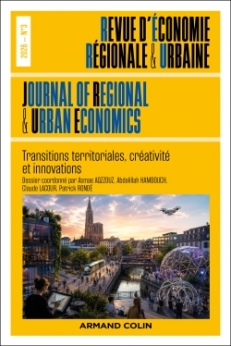
Revue d'économie régionale et urbaine (3/2026)
Transitions territoriale, créativité et innovations
Parution
juin 2026
EAN
9782200936921
Prix au numéro
18 €
Marque
Armand Colin
Pagination
224 pages
Pour acheter ce numéro, contactez-nous
S'abonner
Recevez les numéros de l'année en cours et accédez à l'intégralité des articles en ligne.
Auteur(s)
Asmae Aqzzouz
Abdelillah Hamdouch
Claude Lacour
Patrick Rondé
La créativité et l'innovation, au coeur des transitions et de la résilience territoriale
Résumé
Cet article introductif explore la manière dont les territoires affrontent les crises contemporaines et engagent des transitions économiques, sociales, écologiques et technologiques. Il souligne que la résilience territoriale repose sur la capacité des acteurs à absorber les chocs, à innover et à transformer leurs modèles de développement. Les contributions du colloque de l’ASRDLF 2024 montrent que les transitions sont façonnées par des dynamiques multiscalaires, mêlant gouvernances descendantes, initiatives ascendantes et approches transactionnelles. Elles mettent également en évidence le rôle central de la créativité et de l’innovation (individuelle, collective et territoriale) dans les réponses aux crises. L’article propose enfin une lecture des trajectoires territoriales, marquées par les dépendances de sentier, les bifurcations possibles et les expérimentations locales.
Mots clés
créativité
innovation
Résilience
territoires
transitions
Creativity and Innovation, at the Heart of Territorial Transitions and Resilience
Abstract
This introductory paper examines how territories confront contemporary crises and engage in large-scale transitions, economic, social, ecological and technological. It argues that territorial resilience depends on the ability of local actors to absorb shocks, adapt governance practices, and initiate structural transformations rather than merely restoring pre-crisis condition. Drawing on the contributions presented at the 2024 ASRDLF congress, the article highlights the complexity and diversity of these processes across different spatial contexts. Transitions are shaped by intertwined dynamics: top-down policies set by national and supranational institutions, bottom-up initiatives driven by citizens and local organizations, and transversal forms of polycentric governance. Case studies reveal how historical legacies, institutional inertia, and path dependencies influence territorial capacities to commit to sustainable transitions. Examples include decarbonization challenges in former industrial regions, the agroecological trajectories of insular territories, residential mobility and governance differentiation, and social innovations such as fare-free public transport. Creativity and innovation emerge as key resources that enable territories to respond to crises, experiment with new solutions, and reconfigure socio-economic systems. The article emphasizes the territorial embeddedness of creative dynamics and the role of proximities, networks, cultural assets, and collective learning. Urban spaces, in particular, serve as catalysts for creative clustering and experimentation. Finally, the paper outlines how trajectories of transition unfold over time, depending on actors’ abilities to interpret constraints, negotiate compromises, and build shared strategies. It calls for renewed research on how localized creativity, innovation ecosystems, and inter-territorial collaborations can nurture self-reinforcing resilience and guide territories toward inclusive and sustainable development.
Keywords
creativity
innovation
Resilience
territories
transitions
Citation
Asmae Aqzzouz, Abdelillah Hamdouch, Claude Lacour, Patrick Rondé, « La créativité et l'innovation, au coeur des transitions et de la résilience territoriale », Revue d'économie régionale et urbaine (3/2026), pp. 311-327, Armand Colin. Disponible sur : http://www.revues.armand-colin.com/eco-sc-politique/revue-deconomie-regionale-urbaine/revue-deconomie-regionale-urbaine-32026/creativite-linnovation-au-coeur-transitions-resilience
DANS LA MÊME thématique
Auteur(s)
Asmae Aqzzouz Abdelillah Hamdouch Claude Lacour Patrick Rondé
Revue d'économie régionale et urbaine (3/2026)
Transitions territoriale, créativité et innovations
Parution:
juin 2026

Auteur(s)
Eileen Michel Marc Rouzeau
REVUE D'ÉCONOMIE RÉGIONALE ET URBAINE (2/2024)
Transitions et gouvernance territoriale
Parution:
avril 2024