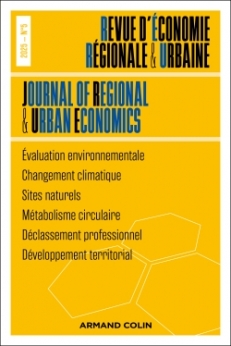
Revue d'économie régionale et urbaine (5/2025)
Varia
Parution
décembre 2025
EAN
9782200936327
Prix au numéro
18 €
Marque
Armand Colin
Pagination
184 pages
Pour acheter ce numéro, contactez-nous
S'abonner
Recevez les numéros de l'année en cours et accédez à l'intégralité des articles en ligne.
Auteur(s)
Chantal Berdier
Mathilde Girault
Muriel Maillefert
Vers un métabolisme circulaire et local des biodéchets ménagers dans l’aire métropolitaine de Lyon. Deux scénarios de valorisation du compost normalisé en agriculture
Résumé
La loi AGEC impose aux collectivités de valoriser les biodéchets ménagers. Dans l’aire métropolitaine de Lyon, il existe un système hybride : composteurs et vermicomposteurs collectifs, plateforme de compostage. Cet article analyse le retour au sol des biodéchets en combinant les approches du métabolisme et de l’économie circulaire. Il discute des conditions de réintroduction locale des biodéchets transformés en compost dans un système de production agricole. A partir d’une enquête de terrain, un métabolisme territorial et une analyse de la ventilation des flux ont été élaborés. Deux scénarios de valorisation agricole locale des biodéchets sont discutés. Ils montrent la faisabilité d’un bouclage territorial « de l’assiette au champ » tout en mettant en lumière des visions différenciées du bouclage. Ce résultat soulève des questions opérationnelles et des questions relatives à l’acceptabilité sociale, économique et de gouvernance.
Mots clés
biodéchet
métabolisme territorial
économie circulaire
agriculture
amendement
A circular and local metabolism of household bio-waste in Lyon conurbation. Two scenarios for using standardised compost in agriculture
Abstract
The AGEC law (n° 2020-105 Fighting waste and the circular economy) requires local authorities to offer households a solution for the recovery of their food waste from 1 January 2024. The Lyon conurbation has set up a hybrid system for managing household biowaste. The current solutions are implemented at different scales: individual (individual composters), neighbourhood (community composters) and semi-industrial (industrial composting). This article proposes a territorial analysis, combining metabolic and circular economy approaches, to examine how urban household waste can be reintroduced into a local production system through composting. This article is based on two approaches. The first is a data collection on composting processes and agricultural amendment. The second is a field study using semi-structured interviews, site visits and local data collection. A flow diagram and a representation of their distribution (by type of composting and outlet) have been drawn up, in order to identify the levers for territorial closure of flows. This is a modelling tool for understanding the collection and management of household biowaste that can be used for public policy purposes. We have developed two scenarios for the reintroduction of biowaste into a local production circle through composting. They are based on four sets of assumptions: political, spatial, economic and agricultural. They show the feasibility of a territorial cycle ’from plate-to-field’ and highlight the role that biowaste management can play in the implementation of a policy of relocalisation of food production. This result raises other operational issues as well as questions about the social, economic and governance acceptability of compost made from household biowaste in agriculture.
Keywords
biowaste
territorial metabolism
circular economy
agriculture
soil improver
Citation
Chantal Berdier, Mathilde Girault, Muriel Maillefert, « Vers un métabolisme circulaire et local des biodéchets ménagers dans l’aire métropolitaine de Lyon. Deux scénarios de valorisation du compost normalisé en agriculture », Revue d'économie régionale et urbaine (5/2025), pp. 841-868, Armand Colin. Disponible sur : http://www.revues.armand-colin.com/eco-sc-politique/revue-deconomie-regionale-urbaine/revue-deconomie-regionale-urbaine-52025/metabolisme-circulaire-local-biodechets-menagers-laire
DANS LA MÊME thématique
Auteur(s)
Chloë Francomme Adèle Brial
REVUE D'ÉCONOMIE RÉGIONALE ET URBAINE (4/2025)
Varia
Parution:
octobre 2025