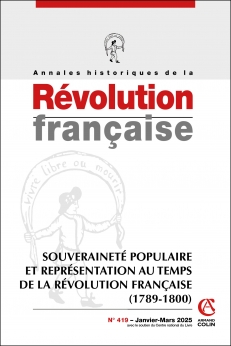
ANNALES HISTORIQUES DE LA RÉVOLUTION FRANÇAISE Nº419 (1/2025)
Souveraineté populaire et représentation au temps de la Révolution française (1789-1800)
Parution
mars 2025
EAN
9782200935948
Prix au numéro
15 €
Marque
Armand Colin
Pagination
216 pages
Pour acheter ce numéro, contactez-nous
S'abonner
Recevez les numéros de l'année en cours et accédez à l'intégralité des articles en ligne.
Auteur(s)
Nicolas Soulas
Thwarted popular aspirations, divergent political projects and the crisis of representation in the pays de vaud/canton of leman (c. 1760-1803)
Abstract
Under the Bernese regime (1536-1798), the Waldensians as subjects of Bern were deprived of any form of sovereignty, and local institutions were not inclusive: a distinction existed between the bourgeois represented by tightly closed urban patriciates, and the residents or foreigners, who were excluded from rights and representation. The circulation of revolutionary ideas and the new political aspirations in the 1790s, however, changed this situation. The Vaudoise Revolution of 1798 gave birth to the Helvetic Republic (1798-1803), founded on the principle of popular sovereignty. The fruits of this revolution were quickly appropriated by the elites − old and new − who sought to limit the political participation of the most modest social categories. Despite the contraction of the new political sphere and the contradictions within the new Republic − unequal representation of individuals, the countryside, and so forth − popular sovereignty did continue within alternative political spaces, which ultimately proved more inclusive than the administrations fashioned for the urban bourgeoisie. A wide range of practices flourished of which the popular insurrection of Bourla-Papey in 1802 was one of the most spectacular manifestations.
Keywords
Switzerland; the Vaudoise Revolution; the Canton of Léman; popular sovereignty; representation
Citation
Nicolas Soulas, « Thwarted popular aspirations, divergent political projects and the crisis of representation in the pays de vaud/canton of leman (c. 1760-1803) », ANNALES HISTORIQUES DE LA RÉVOLUTION FRANÇAISE Nº419 (1/2025), pp. 145-166, Armand Colin. Disponible sur : http://www.revues.armand-colin.com/histoire/annales-historiques-revolution-francaise/annales-historiques-revolution-francaise-no419-12025/thwarted-popular-aspirations-divergent
DANS LA MÊME thématique

Auteur(s)
Sandra Bella Claire Schwartz
Revue d'histoire des sciences (2/2025)
Malebranche et les sciences
Parution:
décembre 2025
Auteur(s)
Michał Balogh
Annales historiques de la Révolution française Nº424 (2/2026)
Varia
Parution:
juin 2026