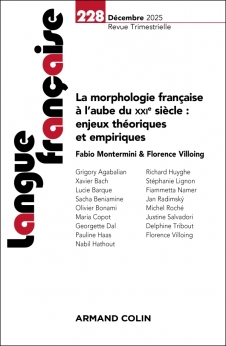
LANGUE FRANÇAISE Nº 228 (4/2025)
La morphologie française à l’aube du XXIe s. : enjeux théoriques et empiriques
Parution
décembre 2025
EAN
9782200936112
Prix au numéro
18 €
Marque
Armand Colin
Pagination
168 pages
Pour acheter ce numéro, contactez-nous
S'abonner
Recevez les numéros de l'année en cours et accédez à l'intégralité des articles en ligne.
Auteur(s)
Sacha Beniamine
Olivier Bonami
Maria Copot
Morphologie implicative et conjugaison du français
Résumé
Cet article retrace l’évolution de l’étude de la conjugaison française depuis l’approche thématique de Bonami & Boyé (2003) jusqu’aux approches implicatives contemporaines. Face aux difficultés structurelles de l’approche thématique, l’approche implicative adopte une perspective abstractive et probabiliste quantifiant les relations d’inter-prédictibilité entre formes fléchies. Deux études empiriques valident cette approche théorique : une analyse computationnelle avec QUMIN et VLEXIQUE2 confirme les intuitions linguistiques sur l’organisation paradigmatique du français, tandis qu’une étude comportementale démontre l’effet de ces relations implicatives sur l’usage des locuteurs. Ces convergences entre formalisation computationnelle, description linguistique et réalité psychologique établissent l’approche implicative comme cadre unifié pour comprendre l’organisation morphologique.
Mots clés
morphologie implicative ; conjugaison française ; théorie de l’information ; relations paradigmatiques ; prédictibilité morphologique
Implicative Morphology and French Conjugation
Abstract
This article documents the shift in studying French conjugation from Bonami & Boyé’s (2003) thematic approach to contemporary implicative approaches. Given the structural problems with the thematic approach, the implicative approach takes an abstractive and probabilistic perspective that quantifies predictive relationships between inflected forms. Two empirical studies validate this theoretical framework: a computational analysis using QUMIN and VLEXIQUE2 employs information theory to confirm linguistic intuitions about French paradigmatic organization, while a behavioral study shows that speakers are sensitive to the implicative relationships the theory predicts. The alignment between computational formalization, linguistic description, and behavioural evidence establishes the implicative approach as a unified framework for understanding morphological organization.
Keywords
Implicative Morphology ; French Conjugation ; Information Theory ; Paradigmatic Relations ; Morphological Predictability
Citation
Sacha Beniamine, Olivier Bonami, Maria Copot, « Morphologie implicative et conjugaison du français », LANGUE FRANÇAISE Nº 228 (4/2025), pp. 23-39, Armand Colin. Disponible sur : http://www.revues.armand-colin.com/lettres-langues/langue-francaise/langue-francaise-no-228-42025/morphologie-implicative-conjugaison-du-francais