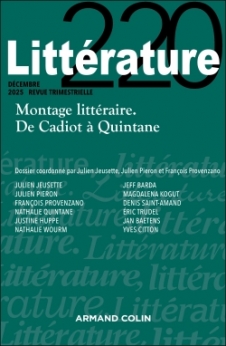
Littérature Nº220 (4/2025)
Montage littéraire. De Cadiot à Quintane
Parution
décembre 2025
EAN
9782200936235
Prix au numéro
18 €
Marque
Armand Colin
Pagination
150 pages
Pour acheter ce numéro, contactez-nous
S'abonner
Recevez les numéros de l'année en cours et accédez à l'intégralité des articles en ligne.
Auteur(s)
Yves Citton
L’atomisation du montage par les GPT : Internes de Grégory Chatonsky
Résumé
Cet article s’aventure dans la composition du livre Internes rédigé par Grégory Chatonsky en coopération avec un Large Language Model. L’artiste, l’IA et le critique littéraire se trouvent pris dans un enchevêtrement analysé en termes de montage, et plus particulièrement d’une réduction d’échelle des opérations de montage, qui s’appliquent désormais au niveau de la probabilité que tel mot succède à quel autre. Dans un tel con-texte de tissure commune, qu’advient-il du créateur ? de l’interprète ? du savant ? de la revue qui accueille ces interrogations auto-corrosives ? Ces réflexions sont à situer dans le cheminement qui nous rapproche de l’état qualifié de « postartificiel » par Hannes Bajohr, un état où la question de savoir qui a écrit est moins importante que l’effort pour mesurer ce que peut nous dire ce qui s’est écrit.
The fragmentation of montage by GPTs : Internes by Grégory Chatonsky
Abstract
This article explores the composition of the novel Internes, co-written by Grégory Chatonsky and a Large Language Model. The artist, the AI and the literary critic are entangled in a shared web analysed in terms of montage, and more specifically a scaled-down montage mechanism, applied to the probability that one particular word will come after another. Bound together in an entanglement such as this, what becomes of the creator ? the interpreter ? the scholar ? the review that embraces these self-corrosive questions ? These reflections must be considered in the context of our journey towards what Hannes Bajohr calls the “post-artificial” state, in which the question of who has written a text is less important than the effort to assess what the writings can tell us.
Citation
Yves Citton, « L’atomisation du montage par les GPT : Internes de Grégory Chatonsky », Littérature Nº220 (4/2025), pp. 124-135, Armand Colin. Disponible sur : http://www.revues.armand-colin.com/lettres-langues/litterature/litterature-no220-42025/latomisation-du-montage-gpt-internes-gregory-chatonsky
DANS LA MÊME thématique

Auteur(s)
Marie-Odile Hidden
LE FRANÇAIS AUJOURD'HUI Nº 229 (2/2025)
Utopies et enseignement du français
Parution:
juin 2025

Auteur(s)
LANGUE FRANÇAISE Nº 228 (4/2025)
La morphologie française à l’aube du XXIe s. : enjeux théoriques et empiriques
Parution:
décembre 2025