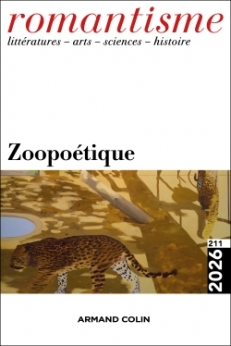
Romantisme N°211 (1/2026)
Parution
mars 2026
EAN
9782200937041
Prix au numéro
20 €
Marque
Armand Colin
Pagination
132 pages
Pour acheter ce numéro, contactez-nous
S'abonner
Recevez les numéros de l'année en cours et accédez à l'intégralité des articles en ligne.
Auteur(s)
Anne-Gaëlle Weber
Des manuels d’élevage d’oiseaux en volière aux volières d’Eugène Scribe dans la première moitié du XIXe siècle : ambivalences de quelques « encagements genrés1 »
Résumé
En 1818 et 1838, Eugène Scribe compose deux livrets pour un vaudeville et un ballet respectivement intitulés La Volière de frère Philippe et La Volière ou les oiseaux de Boccace. L’un et l’autre puisent à la même source tout en se distinguant radicalement par l’inversion des rôles entre personnages masculins et féminins. Ces deux oeuvres sont étudiées au prisme de la « volière », entendue comme un dispositif réel et artistique. Il s’agit de montrer comment les volières, réelles ou non, procèdent systématiquement à une remise en cause des stéréotypes culturels qui président à la cohabitation des animaux et des humains en interrogeant l’identification possible des uns aux autres. La volière devient alors, parce qu’elle est un espace artificiel et naturel, le prétexte à une possible recomposition du champ artistique.
« Manuals for keeping birds in aviaries drawing on Eugène Scribe’s aviaries in the first half of the 19th century: ambivalences of a few “gendered cagings” »
Abstract
In 1818 and 1838, Eugène Scribe composed two librettos for a vaudeville and ballet entitled La Volière de frère Philippe and La Volière ou les oiseaux de Boccace, respectively. Both draw from the same source while radically distinguishing themselves by reversing the roles of male and female characters. This article studies these two works through the prism of the ‘aviary’, understood as a real and artistic device. The aim is to show how aviaries, whether real or not, systematically challenge the cultural stereotypes that govern the cohabitation of animals and humans by exploring how one can identify with the other. The aviary, because it is an artificial and natural space, then becomes the pretext for a possible recomposition of the artistic field.
Citation
Anne-Gaëlle Weber, « Des manuels d’élevage d’oiseaux en volière aux volières d’Eugène Scribe dans la première moitié du XIXe siècle : ambivalences de quelques « encagements genrés1 » », Romantisme N°211 (1/2026), pp. 30-41, Armand Colin. Disponible sur : http://www.revues.armand-colin.com/lettres-langues/romantisme/romantisme-ndeg211-12026/manuels-delevage-doiseaux-voliere-aux-volieres-deugene-scribe-premiere-moitie-du-xixe-siecle
DANS LA MÊME thématique

Auteur(s)
Jean-Yves Mollier
ROMANTISME N°207 (1/2025)
Bibliographie et Histoire littéraire
Parution:
mars 2025