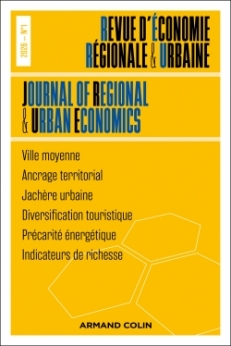
Revue d'économie régionale et urbaine (1/2026)
Parution
février 2026
EAN
9782200936907
Prix au numéro
18 €
Marque
Armand Colin
Pagination
168 pages
Pour acheter ce numéro, contactez-nous
S'abonner
Recevez les numéros de l'année en cours et accédez à l'intégralité des articles en ligne.
Auteur(s)
Achille Warnant
Définir la ville moyenne - Réflexion autour d’une catégorie territoriale à la croisée de la recherche urbaine et de l’action publique
Résumé
Cet article propose de clarifier la notion de ville moyenne en articulant trois dimensions – taille, fonctions, représentations – à partir d’un corpus scientifique, institutionnel et médiatique. Il montre que cette catégorie, bien qu’ancienne et largement mobilisée, demeure floue, oscillant entre critères démographiques variables, rôles territoriaux parfois contradictoires et récits valorisants forgés depuis les années 1970. L’analyse met en évidence le poids des seuils statistiques, la place centrale attribuée aux fonctions de ville-relais, ville-accueil ou ville-étape, ainsi que la force des images associées à la « ville à taille humaine » ou à la « ville où il fait bon vivre ». En définitive, la ville moyenne apparaît comme une construction hybride, plus politique que scientifique, dont l’usage doit être manié avec précaution afin de ne pas occulter la diversité des réalités sociales, économiques et territoriales qu’elle recouvre.
Mots clés
ville moyenne
recherche urbaine
action publique
catégorie territoriale
Géographie
Defining the medium-sized city - Reflections on a territorial category at the crossroads of urban research and public policy
Abstract
This article seeks to clarify the notion of the “medium-sized city” by articulating three dimensions - size, functions, and representations - on the basis of a wide-ranging scientific, institutional, and media corpus spanning more than half a century. It shows that this category, although longstanding and widely mobilized, remains marked by a persistent vagueness: demographic thresholds vary across sources and periods - most often between 20,000 and 100,000 inhabitants, sometimes extended to 200,000 - reflecting not only statistical choices but also political and media uses. The article further interrogates the functions traditionally assigned to medium-sized cities. Portrayed as relay cities, they are said to ensure a double connectivity between hinterlands and metropolitan areas; understood as receiving cities, they would accommodate populations leaving rural areas; seen as stepping-stone cities, they would offer a temporary stage in social and residential mobility trajectories. The analysis demonstrates that these functions, inherited from the territorial planning policies of the 1970s, shed light on certain dynamics but fall short of capturing the diversity of local trajectories. The article also examines the weight of representations. The myths of the “human-scale city” and the “city where life is good”, forged in the context of the 1970s, continue to shape political, media, and communication discourses. It shows that such valorizing images contribute to the legitimization of the category while often obscuring less flattering realities such as deindustrialization, impoverishment, or urban sprawl. Ultimately, the medium-sized city emerges as a hybrid construction, more political than scientific. The article proposes using it in a reflexive way - not to settle on a single definition, but to interpret territorial dynamics and to guide differentiated policies, adjusted to the specific resources and vulnerabilities of each context.
Keywords
middle-sized city
urban research
public policy
territorial category
Geography
Citation
Achille Warnant, « Définir la ville moyenne - Réflexion autour d’une catégorie territoriale à la croisée de la recherche urbaine et de l’action publique », Revue d'économie régionale et urbaine (1/2026), pp. 5-29, Armand Colin. Disponible sur : http://www.revues.armand-colin.com/eco-sc-politique/revue-deconomie-regionale-urbaine/revue-deconomie-regionale-urbaine-12026/definir-ville-moyenne-reflexion-autour-dune-categorie
DANS LA MÊME thématique
Auteur(s)
Michaël Goujon
REVUE D'ÉCONOMIE RÉGIONALE ET URBAINE (2/2025)
Les territoires périphériques et ultrapériphériques face aux crises majeures
Parution:
avril 2025