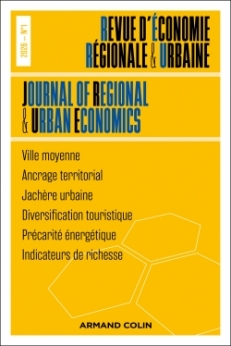
Revue d'économie régionale et urbaine (1/2026)
Parution
février 2026
EAN
9782200936907
Prix au numéro
18 €
Marque
Armand Colin
Pagination
168 pages
Pour acheter ce numéro, contactez-nous
S'abonner
Recevez les numéros de l'année en cours et accédez à l'intégralité des articles en ligne.
Auteur(s)
Fatima Ezzahra KHANFAR
La gestion de la relation investisseur : un catalyseur de l’ancrage territorial des entreprises étrangères - Le cas de Casablanca
Résumé
Ce papier a pour visée d’analyser la contribution de la gestion de la relation investisseur au processus d’ancrage territorial des entreprises étrangères. Nous formulons ainsi notre problématique : « comment les managers territoriaux peuvent-ils favoriser l’ancrage des entreprises étrangères en activant les leviers de la gestion de la relation investisseur ? ». L’exploration de la contribution du marketing territorial relationnel, opérationnalisé par la GRI, à l’ancrage des entreprises est réalisée grâce à une étude de cas unique qui porte sur la capitale économique du Maroc (Casablanca). Ce choix relève d’une approche qualitative qui est en phase avec notre posture épistémologique interprétativiste. Les résultats de cette recherche s’articulent autour de la confirmation de quatre principales propositions de recherche qui portent sur la confiance, l’engagement, la satisfaction et la communication publique territoriale. Le recours à ces leviers par les managers territoriaux est à même de participer à une dynamique d’ancrage des entreprises.
Mots clés
Ancrage territorial
entreprise étrangère
GRC
gestion de la relation investisseur
marketing territorial relationnel
Investor relationship management : a catalyst for the territorial anchoring of foreign companies - The case of Casablanca
Abstract
The aim of this research is to analyze the contribution of investor relationship management (IRM) in the process of territorial anchoring of foreign companies. We formulate our problem as follows: " How can territorial managers encourage the establishment of foreign companies by activating the levers of Investor Relationship Management (IRM)? " ? The exploration of the contribution of relational territorial marketing, operationalized by the GRI, to the anchoring of foreign companies is carried out thanks to a unique case study that focuses on the economic capital of Morocco (Casablanca). This choice is based on a qualitative approach that is in line with our interpretative epistemological posture. The results of this research are based on the confirmation of four main research proposals resulting from the literature review and which concern trust, commitment, satisfaction and territorial public communication. The use of these levers by territorial managers is able to participate in a dynamic of territorial anchoring of foreign companies in a context where the attractiveness of the territory alone is no longer sufficient. Territorial anchoring is becoming a strategic objective, given the exacerbation of competition between territories and the growing mobility of territories. Consequently, territorial managers have every interest in setting up a relational strategy to ensure that their relationships with foreign investors are built over time, a strategy driven by the objective of establishing a spatial, reticular and teleological territorial footing. Our main contribution is to highlight the pillars of a GRI that can help foreign companies to establish themselves in their localities. This result is the result of extrapolating relationship marketing and CRM to territorial marketing.
Keywords
Keywords : CRM
foreign companies
investor relationship management
territorial anchoring
territorial relationship marketing
Citation
Fatima Ezzahra KHANFAR, « La gestion de la relation investisseur : un catalyseur de l’ancrage territorial des entreprises étrangères - Le cas de Casablanca », Revue d'économie régionale et urbaine (1/2026), pp. 31-52, Armand Colin. Disponible sur : http://www.revues.armand-colin.com/eco-sc-politique/revue-deconomie-regionale-urbaine/revue-deconomie-regionale-urbaine-12026/gestion-relation-investisseur-catalyseur-lancrage