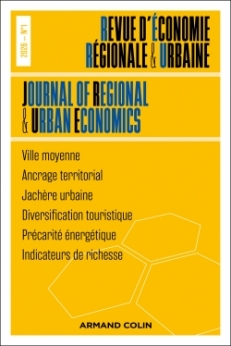
Revue d'économie régionale et urbaine (1/2026)
Parution
février 2026
EAN
9782200936907
Prix au numéro
18 €
Marque
Armand Colin
Pagination
168 pages
Pour acheter ce numéro, contactez-nous
S'abonner
Recevez les numéros de l'année en cours et accédez à l'intégralité des articles en ligne.
Auteur(s)
Yvan Tegui
Résilience et reprise du tourisme : le cas de la diversification touristique
Résumé
La pandémie de COVID19, qui a frappé l’Europe en 2020, a fortement compromis le secteur touristique mondial, avec des trajectoires de reprise variées selon les territoires. Cette étude analyse l’impact de la composition de la clientèle avant la crise et de la diversification géotouristique sur la reprise dans les régions françaises et frontalières. En mobilisant un indicateur de reprise issu de la littérature, un modèle à effets aléatoires et des indices de diversification, nous montrons que les zones présentant une proportion élevée de touristes domestiques et une diversité géotouristique accrue avant la crise connaissent une reprise plus robuste, notamment pour l’accueil de touristes étrangers. Ces résultats soulignent la nécessité pour les décideurs de favoriser la diversité spatiale et structurelle des flux touristiques, et d’appuyer le tourisme de proximité pour réduire la saisonnalité et renforcer la résilience des destinations.
Mots clés
développement régional
diversification touristique
reprise touristique
Résilience
tourisme durable
Resilience and tourism recovery : the case of tourist diversification
Abstract
The COVID19 pandemic profoundly disrupted global tourism, exposing structural vulnerabilities in destinations worldwide. This paper examines how pre-crisis customer base and geotourism diversity influenced the recovery of tourism in France and its neighbouring regions (Spain, Italy, Germany, Belgium, and the Netherlands). Using a modified tourism recovery indicator and diversification indices applied to monthly regional data from 2020 to 2022, our findings reveal that destinations with a higher share of domestic tourists prior to the pandemic recovered more quickly than those relying heavily on international visitors. Furthermore, regions exhibiting greater geotourism diversity, measured through the Shannon-Wiener and Pielou indices, experienced stronger recovery trajectories, particularly in attracting foreign tourists. This spatial diversification allowed tourism activity to adapt to mobility restrictions and shifting traveller preferences, mitigating losses in metropolitan areas through increased activity in rural and urban regions. We observe that domestic tourism acted as a stabilizing force during the crisis, while balanced territorial dispersion of tourist flows enhanced adaptability to shocks. Government restrictions and population density also played a significant role in shaping recovery patterns, underscoring the vulnerability of highly concentrated tourism systems. Neighbouring tourism and proximity travel also emerged as important drivers of resilience, helping destinations reduce seasonality effects and sustain activity during uncertainty. This research contributes to the literature on regional resilience by integrating market and spatial diversification as dual pillars of shock mitigation. Policy implications emphasize the need for differentiated regional strategies that foster diversified demand structures and balanced distribution of attractions. Strengthening these dimensions enhances long-term resilience and competitiveness, ensuring that destinations are better equipped to withstand future crises.
Keywords
regional development
Resilience
sustainable tourism
tourism diversification
tourism recovery
Citation
Yvan Tegui, « Résilience et reprise du tourisme : le cas de la diversification touristique », Revue d'économie régionale et urbaine (1/2026), pp. 73-101, Armand Colin. Disponible sur : http://www.revues.armand-colin.com/eco-sc-politique/revue-deconomie-regionale-urbaine/revue-deconomie-regionale-urbaine-12026/racsilience-reprise-du-tourisme-cas-diversification
DANS LA MÊME thématique
Auteur(s)
Asmae Aqzzouz Abdelillah Hamdouch Claude Lacour Patrick Rondé
Revue d'économie régionale et urbaine (3/2026)
Transitions territoriale, créativité et innovations
Parution:
juin 2026
Auteur(s)
Asmae Aqzzouz Abdelillah Hamdouch Claude Lacour Patrick Rondé
Revue d'économie régionale et urbaine (3/2026)
Transitions territoriale, créativité et innovations
Parution:
juin 2026