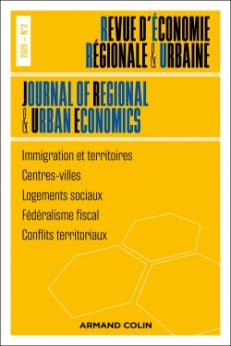
Revue d'économie régionale et urbaine (2/2026)
Parution
avril 2026
EAN
9782200936914
Prix au numéro
18 €
Marque
Armand Colin
Pagination
144 pages
Pour acheter ce numéro, contactez-nous
S'abonner
Recevez les numéros de l'année en cours et accédez à l'intégralité des articles en ligne.
Auteur(s)
Maria Victoria Ramirez Munoz
Francisco Rabadȧn Pérez
María Cortés Ruiz
Capital social et comportement fiscal en Espagne : une perspective en fonction du genre et de la taille de la commune
Résumé
Cette étude analyse les fondements moraux, affectifs et institutionnels du capital social dans le contexte fiscal espagnol. À partir des microdonnées du Centro de Investigaciones Sociológicas (2022), une analyse factorielle exploratoire a permis d’identifier six dimensions latentes — exigence morale fiscale, satisfaction envers les services publics, bien-être subjectif, perception de la charge fiscale, mobilité sociale et normes civiques — ainsi que deux variables uniques : confiance interpersonnelle et positionnement idéologique. La structure factorielle s’est révélée stable et cohérente entre différentes méthodes d’extraction et de traitement des données. Les ANOVA à deux facteurs ont montré des différences modérées mais significatives selon le genre et la taille de la commune : les femmes présentent une éthique civique et une satisfaction publique légèrement supérieures, tandis que les hommes perçoivent davantage de pression fiscale. Les variations territoriales sont faibles mais cohérentes. Globalement, les résultats confirment la stabilité des orientations civiques et l’utilité d’une mesure multidimensionnelle du capital social.
Mots clés
capital social
morale fiscale
confiance institutionnelle
genre
taille municipale
Social capital and fiscal behavior in Spain : a gender and municipality size perspective
Abstract
This study explores the moral, affective, and institutional foundations of social capital in Spain’s fiscal context. Using microdata from the Centro de Investigaciones Sociológicas (2022), an exploratory factor analysis (EFA) identified six latent dimensions—Fiscal moral demand, Public-service satisfaction, Subjective well-being, Perceived tax burden, Social mobility, and Civic norms—together with two standardized single-indicator variables capturing Interpersonal trust and Ideological self-placement. All variables were standardized so that higher scores represent greater intensity of the construct. The factorial structure remained consistent across extraction methods (ML, PAF, ULS) and under both complete-case and imputed data treatments, yielding a stable and replicable measurement of attitudinal dimensions of civic and fiscal behavior. Two-way ANOVAs examined differences by gender and municipality size. Gender effects were modest yet theoretically meaningful: women reported slightly higher ethical commitment, satisfaction with public services, and well-being, whereas men perceived greater fiscal pressure and positioned themselves marginally further to the right on the ideological scale. Territorial variation was limited but coherent—residents of medium and large cities expressed stricter moral expectations and marginally higher interpersonal trust, though the effect sizes were trivial. A single significant interaction in Interpersonal trust revealed that women in larger municipalities showed higher confidence than men, while no gender gap appeared in smaller localities. Overall, these results indicate a qualified stability of civic orientations across demographic contexts. Methodologically, the study provides statistically robust evidence that social capital can be consistently assessed as a multidimensional attitudinal construct through convergent factor extraction, reliability diagnostics, and inferential validation. Substantively, the results indicate that Spain’s civic culture combines strong moral commitment with moderate distributive skepticism. Policies promoting transparency, fairness, and civic education could further strengthen the moral and affective foundations of fiscal cooperation and social cohesion.
Keywords
social capital
tax morale
institutional trust
gender
municipality size
Citation
Maria Victoria Ramirez Munoz, Francisco Rabadȧn Pérez, María Cortés Ruiz, « Capital social et comportement fiscal en Espagne : une perspective en fonction du genre et de la taille de la commune », Revue d'économie régionale et urbaine (2/2026), pp. 257-284, Armand Colin. Disponible sur : http://www.revues.armand-colin.com/eco-sc-politique/revue-deconomie-regionale-urbaine/revue-deconomie-regionale-urbaine-22026/capital-social-comportement-fiscal-espagne-perspective
DANS LA MÊME thématique
Auteur(s)
Jean-Marc Callois
Revue d'économie régionale et urbaine (5/2025)
Varia
Parution:
décembre 2025