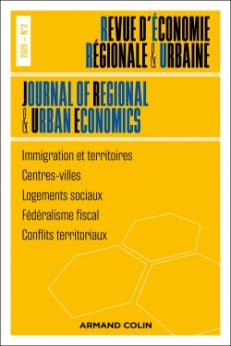
Revue d'économie régionale et urbaine (2/2026)
Parution
avril 2026
EAN
9782200936914
Prix au numéro
18 €
Marque
Armand Colin
Pagination
144 pages
Pour acheter ce numéro, contactez-nous
S'abonner
Recevez les numéros de l'année en cours et accédez à l'intégralité des articles en ligne.
Auteur(s)
Véronique Chadillon-Farinacci
Niangoran Fabien Ekue
Ellie Côté
Les conflits de territoire de pêche de homard des Maritimes du Canada : une approche par la théorie des jeux
Résumé
Cette étude explore les conflits de territoire de pêche au homard dans les provinces maritimes du Canada sous le prisme des règles formelles et informelles de l’usage des zones de capture. Nous mobilisons la théorie des jeux pour analyser ces conflits territoriaux à partir de décisions judiciaires et d’articles médiatiques publiés sur près de 20 ans (n=103). Ces cas illustrent le positionnement de deux pêcheurs dans un jeu non coopératif. L’identification des équilibres de Pareto et de Nash éclaire les interactions stratégiques actives, passives ou impliquant un tiers. Les résultats soulignent l’importance du rôle du régulateur dans la gestion des conflits de territoires ; les pêcheurs qui n’adhèrent pas aux règles informelles se trouvent en situation de vulnérabilité. Cette recherche propose des pistes pour des politiques favorisant la cohabitation dans les zones de pêche au homard.
Mots clés
pêches commerciales du homard
conflits territoriaux
théorie des jeux
The Lobster Fishing Territory Conflicts in the Canadian Maritimes : A Game-Theory Approach
Abstract
This study explores lobster fishing territory conflicts in the maritime provinces of Canada related to formal and informal rules governing access to harvesting areas. Game theory is used to analyze these territorial conflicts. The methodology is based on court decisions and media articles published over a period of almost 20 years (n=103), allowing us to represent the positioning of fishermen in a non-cooperative two-player game. These strategies have been grouped according to three levels of activity of the fishermen involved in the conflict. Some strategies are active, such as predation and retaliation; others rely on the assistance of a third party, whether it be the authorities or another third party. These two types of strategy are the most widely documented in the analysis. The third type of strategy is based on inaction. This type of strategy combines tolerance and avoidance. The identification of Pareto and Nash equilibria provides a better understanding of strategic interactions between players. Pareto equilibrium is achieved when both players choose passive strategies. Nash equilibrium is achieved when the first player chooses an active strategy, and the second player involves a third party. The player adhering to informal rules holds a strategic advantage, regardless of the conflict’s outcome. Therefore, fishermen who do not adhere to informal rules find themselves in a vulnerable position. The results highlight the importance of the regulator’s role in managing lobster fishing territory conflicts. The involvement of a third party can either mitigate losses or exacerbate tensions, depending on its capacity to act and the level of intervention provided. This research offers perspectives for the development of public policies promoting peaceful cohabitation in commercial lobster fishing areas by integrating formal and informal rules to address tensions and preserve community identity.
Keywords
commercial lobster fishing
territorial conflicts
game theory
Citation
Véronique Chadillon-Farinacci, Niangoran Fabien Ekue, Ellie Côté, « Les conflits de territoire de pêche de homard des Maritimes du Canada : une approche par la théorie des jeux », Revue d'économie régionale et urbaine (2/2026), pp. 285-303, Armand Colin. Disponible sur : http://www.revues.armand-colin.com/eco-sc-politique/revue-deconomie-regionale-urbaine/revue-deconomie-regionale-urbaine-22026/conflits-territoire-peche-homard-maritimes-du-canada