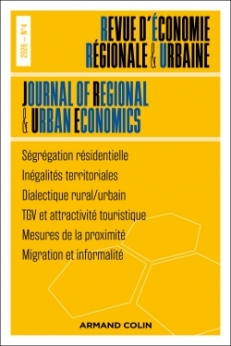
Revue d'économie régionale et urbaine (4/2026)
Parution
octobre 2026
EAN
9782200936938
Prix au numéro
18 €
Marque
Armand Colin
Pagination
176 pages
Pour acheter ce numéro, contactez-nous
S'abonner
Recevez les numéros de l'année en cours et accédez à l'intégralité des articles en ligne.
Auteur(s)
Ameziane Ben Allak
Andrea Almawi
Dialectique rural/urbain, l'osmose inattendue en montagne ? Cas des territoires montagneux de la wilaya de Tizi-Ouzou (Algérie)
Résumé
Le présent article traite de la problématique de l’urbanisation en zone de montagne dans la wilaya de Tizi-Ouzou, en Algérie. Le fait montagnard est indéniable dans cette zone géographique réputée pour son armature villageoise dense et en hauteur. Depuis la moitié du XXᵉ siècle, une transition du rural à l’urbain commence à s’opérer, donnant naissance à des centres urbains aux identités atypiques, à mi-chemin entre bourg et ville intermédiaire. Nous verrons les implications de l’urbanisation sur cette zone, notamment par le mode de vie et le choix de localisation entre le rural et l’urbain des différents agents (acteurs) en montagne. Notre recherche s’est principalement appuyée sur un travail de terrain réalisé dans les localités du massif montagneux du Djurdjura. Pour ce faire, l’approche méthodologique adoptée est de nature qualitative. Au-delà de la visée descriptive de l’organisation spatiale, nous constatons un équilibre implicite entre forces centrifuges et centripètes dans le maintien de l’équilibre entre ruralité et urbanité au massif montagneux du Djurdjura.
Mots clés
villes intermédiaires
Massif montagneux du Djurdjura
Algérie
transition urbaine
aménagement du territoire
Rural/Urban Dialectic : An Unexpected Osmosis in the Mountains ? The Case of the Mountain Territories of the Wilaya of Tizi-Ouzou (Algeria)
Abstract
This article examines the specific dynamics of urbanization in the mountainous regions of the wilaya of Tizi-Ouzou, located in the Djurdjura massif in Algeria. Characterized by a dense network of high-altitude villages, this region has experienced, since the mid-twentieth century, a gradual transition from rural settlement patterns to urban centers with a unique identity, situated halfway between market towns and an intermediate city. These urban formations result from exogenous and largely state-driven interventions linked to post-independence development policies, later reshaped by the introduction of market mechanisms. This study aims to understand how this specific form of mountain urbanization reshapes territorial organization, lifestyles, and residential choices, while questioning the classical rural/urban dichotomy. It adopts a qualitative methodological approach based on extensive fieldwork conducted in Upper Kabylia, focusing on three mountain municipalities: Aïn-El-Hammam, Larbaâ-Nath-Irathen, and Mekla. The empirical material combines institutional interviews with local actors and semi-structured interviews with residents and economic agents, complemented by in situ observations and two micro-surveys on weekly markets and commuting mobility. The results highlight that urbanization in the Djurdjura follows a hybrid trajectory, marked by the coexistence of a socialist institutional legacy and the progressive incorporation of capitalist dynamics. Mountain towns function primarily as spaces of consumption and access to amenities rather than as productive centers, while weekly markets play a central role in structuring urban centrality and maintaining strong links with the rural hinterland. Residential choices reflect an arbitration between the quality of life offered by village environments and the opportunities provided by proximity to urban services. Beyond its descriptive dimension, the analysis reveals an implicit and fragile balance between centrifugal and centripetal forces that sustains a continuous exchange between rural and urban spaces. This territorial configuration produces an “unexpected osmosis” in which urbanity develops in interaction with rurality without replacing it.
Keywords
intermediate cities
Djurdjura
Algeria
Urban Transition
Territorial Planning
Citation
Ameziane Ben Allak, Andrea Almawi, « Dialectique rural/urbain, l'osmose inattendue en montagne ? Cas des territoires montagneux de la wilaya de Tizi-Ouzou (Algérie) », Revue d'économie régionale et urbaine (4/2026), pp. 587-616, Armand Colin. Disponible sur : http://www.revues.armand-colin.com/eco-sc-politique/revue-deconomie-regionale-urbaine/revue-deconomie-regionale-urbaine-42026/dialectique-ruralurbain-losmose-inattendue-montagne-cas