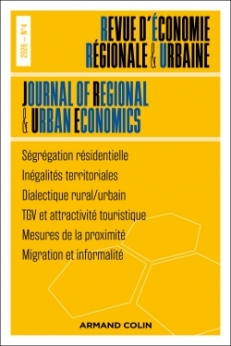
Revue d'économie régionale et urbaine (4/2026)
Parution
octobre 2026
EAN
9782200936938
Prix au numéro
18 €
Marque
Armand Colin
Pagination
176 pages
Pour acheter ce numéro, contactez-nous
S'abonner
Recevez les numéros de l'année en cours et accédez à l'intégralité des articles en ligne.
Auteur(s)
Yvan Tegui
Marta L. SuãRez-Tostado
Train à grande vitesse et attractivité touristique : nouvelles preuves empiriques en Espagne
Résumé
L’expansion des réseaux de train à grande vitesse (TGV) est souvent présentée comme un levier du développement touristique, mais son impact réel reste débattu. Cet article propose de nouvelles preuves empiriques sur l’effet du TGV sur les flux touristiques bilatéraux en Espagne, à partir d’un modèle de gravité. En tenant compte des liaisons directes entre régions d’origine et de destination, notre analyse permet d’évaluer plus finement la manière dont la connectivité interrégionale influence la demande touristique. Les résultats montrent que le TGV accroît significativement les flux touristiques, avec des effets plus marqués dans les régions rurales et non côtières que dans les zones métropolitaines. Ils mettent également en évidence le rôle du TGV dans la promotion d’un tourisme plus durable. Ces conclusions soulignent l’importance d’une stratégie d’expansion du TGV attentive aux disparités territoriales, aux objectifs de durabilité et à la résilience économique de long terme.
Mots clés
développement régional
attractivité touristique
économie des transports
High-speed rail and Tourism attractiveness : New empirical evidence from Spain
Abstract
The expansion of High-Speed Rail (HSR) networks has been widely regarded as a key factor in enhancing tourism development, yet its true impact remains a subject of considerable debate. While some studies highlight its role in boosting destination attractiveness, others point to limitations such as displacement effects or the exacerbation of regional inequalities. This paper contributes to this debate by providing new empirical evidence on the impact of HSR on bilateral tourism flows in Spain, a country with one of the world’s most extensive HSR networks. Unlike previous research that often assesses HSR’s effects at an aggregate level, our study adopts a more granular approach. We analyze a panel of monthly bilateral tourism flows between Spanish provinces from 2019 to 2023, using a gravity model to specifically test the effect of direct HSR connections between origin and destination pairs. Our results confirm that the establishment of a direct High-Speed Rail link significantly increases bilateral tourism flows. However, the magnitude of this effect is highly heterogeneous and depends on regional characteristics. We find that rural and non-coastal regions benefit the most from the improved accessibility HSR provides, whereas the effect is considerably weaker or statistically insignificant in metropolitan and coastal areas that are already well-connected. Furthermore, our findings underscore the role of HSR in promoting sustainable tourism by offering a lower-carbon alternative to short-haul flights and car travel. These insights are valuable for policymakers, advocating for a targeted approach to HSR expansion that considers regional disparities, supports balanced territorial development, and advances long-term economic and environmental sustainability goals.
Keywords
high-speed rail
regional development
tourism attractiveness
transportation economics
Citation
Yvan Tegui, Marta L. SuãRez-Tostado, « Train à grande vitesse et attractivité touristique : nouvelles preuves empiriques en Espagne », Revue d'économie régionale et urbaine (4/2026), pp. 617-644, Armand Colin. Disponible sur : http://www.revues.armand-colin.com/eco-sc-politique/revue-deconomie-regionale-urbaine/revue-deconomie-regionale-urbaine-42026/train-grande-vitesse-attractivite-touristique-nouvelles
DANS LA MÊME thématique
Auteur(s)
Coline Louis Romain Gaté
REVUE D'ÉCONOMIE RÉGIONALE ET URBAINE (4/2024)
Varia
Parution:
octobre 2024
Auteur(s)
Yvan Tegui
Revue d'économie régionale et urbaine (1/2026)
Parution:
février 2026