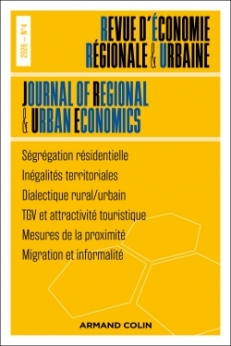
Revue d'économie régionale et urbaine (4/2026)
Parution
octobre 2026
EAN
9782200936938
Prix au numéro
18 €
Marque
Armand Colin
Pagination
176 pages
Pour acheter ce numéro, contactez-nous
S'abonner
Recevez les numéros de l'année en cours et accédez à l'intégralité des articles en ligne.
Auteur(s)
Cyril Verdier
Proximité, une heuristique des relations interindividuelles des membres d'une organisation : proposition et validation d'un instrument de mesure
Résumé
Cet article contribue au développement méthodologique du programme de recherche de l’École de la proximité sur la définition d’une formalisation et d’une mesure robuste de la proximité. Nous proposons un instrument de mesure des dimensions géographique, organisationnelle, institutionnelle, cognitive et sociale de la proximité permettant d’identifier, décrire et analyser les interactions entre les acteurs économiques, et plus particulièrement dans notre étude des relations interindividuelles des membres d’une organisation. A partir d’un jeu de données de 750 observations collectées avec une enquête, nous démontrons la robustesse statistique de l’instrument de mesure proposé, ainsi que sa souplesse d’application à différents profils de répondants. Cette étude appuie le fort potentiel heuristique du cadre d’analyse de la proximité et encourage à le développer encore davantage pour mieux apprécier la coordination des acteurs économiques.
Mots clés
capacité heuristique
enquête
instrument de mesure
proximité
relations interindividuelles
Proximity, a heuristic of an organisation members’s relationships : Measurement instrument proposition and validation
Abstract
This article contributes to the methodological development of the School of Proximity’s research program on defining a formalization and robust measurement of proximity. We propose a measurement instrument of the geographical, organizational, institutional, cognitive, and social dimensions of proximity, enabling to identify, describe, and analyze the interactions between economic actors, and more specifically in our study, the interindividual relationships between members of an organization. This measurement instrument significantly develops those initiated in previous research, with, on the one hand, the creation of geographical proximity measure based on factors that enable to apprehend the crossing of distance, and, on the other hand, a revision of each other proximity dimensions items to improve their respective measurement. Using a dataset of 750 observations collected at a French university through a survey conducted in March 2021, we demonstrate the statistical robustness of the proposed measurement instrument with high acceptability thresholds, as well as its flexibility in application to different respondent profiles by ensuring the representativeness of the subsampling. This demonstration is based on the optimization of an exploratory factor solution, the internal reliability of the emerging factors corresponding to the dimensions of proximity, and a confirmatory factor analysis whose goodness of fit attesting the measurement instrument robustness. Thus, our article (1) corroborates the possibility of extracting the relationships between economic actors from a field study by mobilizing the proximity analysis framework, (2) supports its strong heuristic potential, and (3) encourages its further development to better assess the coordination of economic actors.
Keywords
heuristic ability
survey
measurement tool
proximity
relationships
Citation
Cyril Verdier, « Proximité, une heuristique des relations interindividuelles des membres d'une organisation : proposition et validation d'un instrument de mesure », Revue d'économie régionale et urbaine (4/2026), pp. 645-668, Armand Colin. Disponible sur : http://www.revues.armand-colin.com/eco-sc-politique/revue-deconomie-regionale-urbaine/revue-deconomie-regionale-urbaine-42026/proximite-heuristique-relations-interindividuelles-membres