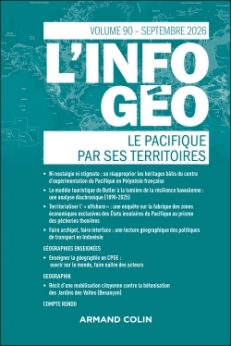
L'information géographique (3/2026)
Le Pacifique par ses territoires
Parution
septembre 2026
EAN
9782200936815
Prix au numéro
15 €
Marque
Armand Colin
Pagination
120 pages
Pour acheter ce numéro, contactez-nous
S'abonner
Recevez les numéros de l'année en cours et accédez à l'intégralité des articles en ligne.
Auteur(s)
Florence Mury
Ni nostalgie ni stigmate : se réapproprier les héritages bâtis du centre d’expérimentation du Pacifique en Polynésie française
Résumé
Cet article interroge les recompositions territoriales à l’oeuvre après la fermeture du Centre d’Expérimentation du Pacifique (CEP) à Hao, Tureia et Mangareva. L’étude se focalise sur le devenir des anciens bâtiments du CEP entre déconstruction et réappropriation fonctionnelle ou patrimoniale. À distance des lectures en termes de « nostalgie nucléaire » ou de stigmate territorial, l’analyse montre que les pratiques de réappropriation constituent des réponses situées à une triple contrainte : la persistance des risques, le déclassement socio-spatial post-CEP et la rareté de certaines ressources. Ces bâtiments deviennent alors des supports matériels et symboliques pour maintenir dans le temps des formes de compensation et de reconnaissance. À l’inverse, là où la reconversion économique est assurée, comme à Mangareva, l’effacement apparaît plus acceptable. Ces configurations différenciées invitent à penser la dénucléarisation non plus comme un simple démantèlement piloté par l’État, mais comme un processus à la fois situé et négocié, révélant le poids d’une agentivité locale.
Mots clés
dénucléarisation
agentivité
réappropriation
héritages nucléaires
Polynésie française
Neither nostalgia nor stigma : reclaiming the built heritage of the centre d’expérimentation of Pacifique (CEP) in French polynesia
Abstract
This article examines the territorial reconfigurations underway following the closure of the Centre d’Expérimentation du Pacifique (CEP) in Hao, Tureia, and Mangareva. The study focuses on the evolution of the former CEP buildings, between demolition and functional or heritage reappropriation. Far from interpretations in terms of “nuclear nostalgia” or territorial stigma, the analysis shows that reappropriation practices constitute localized responses to a triple constraint: the persistence of risks, post-CEP socio-spatial decline, and the scarcity of certain resources. These buildings then become material and symbolic supports for maintaining forms of compensation and recognition over time. In contrast, where economic conversion is assured, as in Mangareva, demolition appears more acceptable. These differentiated configurations invite us to think of denuclearization not as a simple dismantling process led by the state, but as a process that is both localized and negotiated, revealing the weight of local agency.
Keywords
denuclearization
agency
reappropriation
nuclear legacies
French Polynesia
Citation
Florence Mury, « Ni nostalgie ni stigmate : se réapproprier les héritages bâtis du centre d’expérimentation du Pacifique en Polynésie française », L'information géographique (3/2026), pp. 16-36, Armand Colin. Disponible sur : http://www.revues.armand-colin.com/geographie/linformation-geographique/linformation-geographique-ndeg32026/nostalgie-stigmate-se-reapproprier-heritages-batis-du-centre-dexperimentation
DANS LA MÊME thématique
Auteur(s)
Caroline Desbois-Dalmon
L'INFORMATION GÉOGRAPHIQUE (3/2024)
Nature(s) sportive(s)
Parution:
septembre 2024