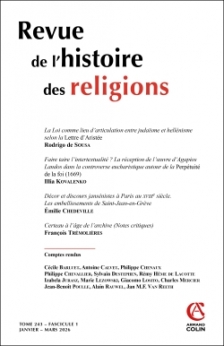
Revue de l'histoire des religions (1/2026)
Parution
mars 2026
EAN
9782200936518
Prix au numéro
18 €
Marque
Armand Colin
Pagination
160 pages
Pour acheter ce numéro, contactez-nous
S'abonner
Recevez les numéros de l'année en cours et accédez à l'intégralité des articles en ligne.
Auteur(s)
Illia Kovalenko
Faire taire l’intertextualité ? La réception de l’oeuvre d’Agapios Landos dans la controverse eucharistique autour de la Perpétuité de la foi (1669)
Résumé
Nous interrogeons la réception du Salut des pécheurs d’Agapios Landos dans le premier tome de la Perpétuité de la foi. Ayant identifié la collection des ouvrages consultée par les Messieurs de Port- Royal, nous y analysons la construction de l’image d’Agapios devenant un archétype d’athonite orthodoxe témoin de la foi dans la présence réelle et dans la nécessité des « bonnes dispositions » pour communier dignement. En revanche, l’ouvrage d’Agapios est fortement inspiré par des sources catholiques, et ce substrat interconfessionnel est caché délibérément par l’auteur lui- même et par les théologiens français, tandis que la surconfessionnalisation de l’image d’Agapios se fait dans les deux cas par rapport aux enjeux intraconfessionnels propres à l’orthodoxie grecque et au catholicisme français.
Silencing Intertextuality ? Reception of the Works of Agapios Landos in the French Eucharistic Controversy Surrounding the Perpétuité de la foi (1669)
Abstract
This article examines the reception of the Salut des pécheurs by Agapios Landos in the first volume of the Perpétuité de la foi. Having identified the collection of works consulted by French theologians, we analyse the construction of the image of Agapios as an archetype of an Orthodox Athonite, affirming faith in the real presence of Christ in the Eucharist, and the need for “good dispositions” in order to receive communion worthily. Nevertheless, Agapios’s work is strongly inspired by Catholic sources, and this interconfessional substratum is deliberately hidden by the author himself and by French theologians, while the overconfessionalisation of the image of Agapios, by both these parties, relates in each case to the intraconfessional issues specific to Greek Orthodoxy and French Catholicism.
Citation
Illia Kovalenko, « Faire taire l’intertextualité ? La réception de l’oeuvre d’Agapios Landos dans la controverse eucharistique autour de la Perpétuité de la foi (1669) », Revue de l'histoire des religions (1/2026), pp. 29-72, Armand Colin. Disponible sur : http://www.revues.armand-colin.com/histoire/revue-lhistoire-religions/revue-lhistoire-religions-12026/faire-taire-lintertextualite-reception-loeuvre-dagapios-landos-controverse
DANS LA MÊME thématique
Auteur(s)
Bastien Dallet
Annales historiques de la Révolution française Nº422 (4/2025)
Varia
Parution:
décembre 2025

Auteur(s)
Déborah Cohen Yann-Arzel Durelle-Marc Carla Hesse Christophe Le Digol Virginie Martin Anne Simonin
ANNALES HISTORIQUES DE LA RÉVOLUTION FRANÇAISE Nº418 (4/2024)
Varia
Parution:
décembre 2024