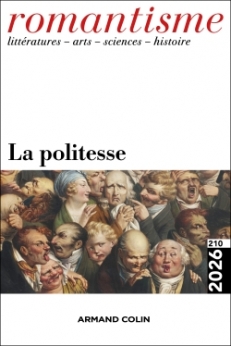
Romantisme N°210 (4/2025)
La politesse
Parution
décembre 2025
EAN
9782200936426
Prix au numéro
20 €
Marque
Armand Colin
Pagination
144 pages
Pour acheter ce numéro, contactez-nous
S'abonner
Recevez les numéros de l'année en cours et accédez à l'intégralité des articles en ligne.
Auteur(s)
Jeanne Barangé
« Sinon impertinente, du moins brusque » : politesse et sentiment national dans Jane Eyre de Charlotte Brontë
Résumé
Cet article étudie le lien entre politesse et sentiment national dans le roman de Charlotte Brontë, Jane Eyre (1847). La représentation de la politesse, dans ce roman, fait écho à l’élan national qui a lieu au XIXe siècle pour définir l’identité anglaise. L’oeuvre présente Jane comme une figure marginale qui, par son cheminement de l’enfance à l’âge adulte, trouve progressivement sa place dans la société anglaise. Initialement rabrouée pour ses réactions passionnées et comparée à une étrangère, elle apprend à maîtriser les conventions pour mieux les déconstruire. Cet aller-retour entre docilité et impertinence permet au personnage de négocier à la fois sa position dans la hiérarchie sociale et sa position en tant que femme dans la société victorienne. Par la représentation du rapport ambivalent que Jane entretient avec la politesse, le roman célèbre la notion d’Englishness, tout en questionnant sa définition.
« “If not blunt, at least brusqueˮ: politeness and national sentiment in Charlotte Brontë’s Jane Eyre »
Abstract
This article explores the link between politeness and national sentiment in Charlotte Brontë’s novel, Jane Eyre (1847). The representation of politeness in this work reflects the national impetus to define Englishness during the 19th century. The novel presents Jane as a marginal figure who, as she journeys from child to adult, gradually finds her place in English society. Initially reprimanded for her impassioned responses and compared to a foreigner, she learns to grasp the rules of decorum in order to better deconstruct them. Switching between docility and impertinence enables her to negotiate her position both in the social hierarchy and as a woman in Victorian society. In its representation of Jane’s ambivalent relationship with politeness, the novel showcases the concept of Englishness while questioning its definition.
Citation
Jeanne Barangé, « « Sinon impertinente, du moins brusque » : politesse et sentiment national dans Jane Eyre de Charlotte Brontë », Romantisme N°210 (4/2025), pp. 55-67, Armand Colin. Disponible sur : http://www.revues.armand-colin.com/lettres-langues/romantisme/romantisme-ndeg210-42025/sinon-impertinente-du-moins-brusque-politesse-sentiment-national-jane-eyre-charlotte-bronte
DANS LA MÊME thématique

Auteur(s)
Thomas Picard
Le Français aujourd'hui Nº231 (4/2025)
Parution:
décembre 2025

Auteur(s)
Christophe Benzitoun
LE FRANÇAIS AUJOURD'HUI Nº223 (4/2023)
Nouvelles pratiques en orthographe
Parution:
décembre 2023