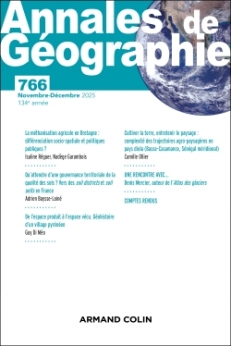
Annales de géographie - N°766 (6/2025)
Parution
décembre 2025
EAN
9782200935931
Prix au numéro
20 €
Marque
Armand Colin
Pagination
120 pages
S'abonner
Recevez les numéros de l'année en cours et accédez à l'intégralité des articles en ligne.
Auteur(s)
Isaline Réguer
Nadège Garambois
La méthanisation agricole en Bretagne : différenciation socio-spatiale et politiques publiques
Résumé
Les politiques publiques en soutien à la méthanisation agricole ont permis son développement croissant depuis une quinzaine d’années en France et en particulier en Bretagne. Ces politiques ont permis d’instaurer un cadre réglementaire sécurisant, qui facilite les investissements des agriculteurs et accroît notablement leur revenu, ce qui explique la progression du nombre d’unités installées. Pourtant, ce développement engendre de profonds effets territoriaux, de l’échelle régionale jusqu’à celle des exploitations agricoles. Basé sur une recherche en Agriculture Comparée, fondée sur une démarche multi-scalaire et un travail approfondi de terrain en Bretagne au sein du bassin rennais et du bassin du Gouessant, cet article révèle que la méthanisation renforce la différenciation socio-spatiale préexistante entre les exploitations agricoles, en s’insérant au sein des plus grandes exploitations agricoles bretonnes, et contribue à creuser les inégalités entre agriculteurs. Cette recherche révèle les limites de cette politique énergétique nationale sous l’angle de l’équité et met ainsi en perspective les évolutions des politiques régionales bretonnes face à ces effets territoriaux.
Mots clés
méthanisation agricole
Bretagne
politiques publiques
impact territorial
Inégalités socio-spatiales
agriculture comparée
Agricultural anaerobic digestion in Brittany : socio-spatial differentiation and public policies
Abstract
Public policies supporting agricultural anaerobic digestion have led to an increase in the use of this process in France over the last fifteen years, particularly in Brittany. These policies have created a secure regulatory framework that makes it easier for farmers to invest and significantly increases their income, which explains the rise in the number of units installed. However, this expansion has had significant territorial impacts at both regional and farm levels. Based on research in Comparative Agriculture, drawing founded on a multi-scalar approach and in-depth fieldwork in Brittany within the Rennes and Gouessant basins, this article shows that anaerobic digestion reinforces the pre-existing socio-spatial differentiation between farms, due to its integration in the largest Breton farms, and contributes to growing widening inequality between farmers. This research highlights the limitations of the national energy policy in terms of equity. It also puts into perspective the development of regional policies in Brittany in response to these territorial effects.
Keywords
anaerobic digestion
Brittany
public policies
territorial impact
Socio-spatial inequalities
comparative agriculture
Citation
Isaline Réguer, Nadège Garambois, « La méthanisation agricole en Bretagne : différenciation socio-spatiale et politiques publiques », Annales de géographie - N°766 (6/2025), pp. 5-29, Armand Colin. Disponible sur : http://www.revues.armand-colin.com/geographie/annales-geographie/annales-geographie-ndeg766-62025/methanisation-agricole-bretagne-differenciation-socio-spatiale-politiques-publiques
DANS LA MÊME thématique
Auteur(s)
Ludovic Falaix
L'INFORMATION GÉOGRAPHIQUE (3/2024)
Nature(s) sportive(s)
Parution:
septembre 2024

Auteur(s)
Emmanuel Roux Frédéric Santamaria
L'INFORMATION GÉOGRAPHIQUE (2/2024)
Les petites villes : examen d’un retour d’intérêt
Parution:
juin 2024