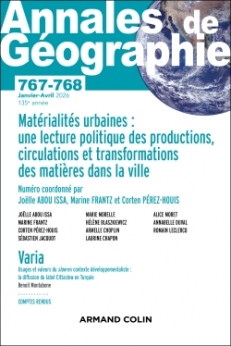
Annales de géographie - N°767-768 (1-2/2026)
Parution
avril 2026
EAN
9782200936556
Prix au numéro
40 €
Marque
Armand Colin
Pagination
192 pages
Pour acheter ce numéro, contactez-nous
S'abonner
Recevez les numéros de l'année en cours et accédez à l'intégralité des articles en ligne.
Auteur(s)
Alice Moret
Gazbeton et kalekim : construire vite et à bas bruit sur les rives du Bosphore (Istanbul, Turquie)
Résumé
En prenant l’exemple des quartiers riverains du Bosphore à Istanbul, je tire le fil des matériaux de construction utilisés pour construire ou aménager l’habitat afin de comprendre qui construit, comment, dans quelles conditions, avec quels moyens, à quel rythme, avec quelles contraintes et quelles stratégies. J’observe notamment que l’utilisation de matériaux peu chers confirme la construction par des populations ouvrières, tandis que l’usage du bois témoigne des migrations depuis la région de la mer Noire, notamment de populations lazes. Le recours au béton permet un habitat évolutif, incrémental, qui correspond ainsi aux moyens, aux besoins et aux contextes sociaux, économiques, politiques, réglementaires. Le choix des matériaux indique aussi le rôle important des acteurs non professionnels, qui s’explique par les moyens financiers réduits ou par le cadre réglementaire (les professionnels refusent parfois les chantiers dans les zones non ouvertes à l’urbanisation). Enfin, l’usage de matériaux légers, maniables sans machines, est l’indice d’une construction à bas bruit, qui se fait discrète, dans un contexte d’interdiction ou de limitations des constructions, ajouts et aménagements, dans certaines zones protégées autour du Bosphore. Les matériaux de construction sont ainsi les révélateurs des conditions de production de l’espace urbain, en apportant des indices sur les acteurs, les rythmes, le statut du sol, tant du point de vue de la propriété que des réglementations urbaines.
Mots clés
Istanbul
urbanisation
matériaux de construction
ville ordinaire
informalité
habitat évolutif/incrémental
auto-construction
acteurs
rythmes
Gazbeton and kalekim : building quickly and quietly on the banks of the Bosphorus (Istanbul, Turkey)
Abstract
Using the banks of the Bosphorus in Istanbul as an example, I trace the history of some building materials used to construct or develop housing, in order to understand who builds, how, under what conditions, with what resources, at what pace, with what constraints and what strategies... The use of inexpensive materials confirms that construction was carried out by working-class populations, while the use of wood bears witness to the migration of Laze populations or populations from the Black Sea region. The use of concrete means that housing can evolve over time, in line with resources, needs and social, economic, political and regulatory contexts. The choice of materials also points to the important role played by non-professionals, which can be explained by limited financial resources or the regulatory framework, as professionals sometimes refuse to build in areas not open to urbanisation. Lastly, the use of lightweight materials that can be handled without machinery is indicative of discreet, low-noise construction, in a context where construction, additions and alterations are banned or restricted in certain protected areas around the Bosphorus. Building materials thus reveal the conditions under which the urban space is produced, providing clues about the actors involved, the pace of work and the status of the land, in terms of both ownership and urban regulations.
Keywords
Istanbul
urbanization
building materials
ordinary city
informality
evolving/ incremental housing
self-build housing
actors
rhythms
Citation
Alice Moret, « Gazbeton et kalekim : construire vite et à bas bruit sur les rives du Bosphore (Istanbul, Turquie) », Annales de géographie - N°767-768 (1-2/2026), pp. 90-114, Armand Colin. Disponible sur : http://www.revues.armand-colin.com/geographie/annales-geographie/annales-geographie-ndeg767-768-1-22026/gazbeton-kalekim-construire-vite-bas-bruit-rives-du-bosphore-istanbul-turquie
DANS LA MÊME thématique
Auteur(s)
Camille Tiano
L'information géographique (3/2026)
Le Pacifique par ses territoires
Parution:
septembre 2026
Auteur(s)
Julie Gangneux-Kebe
L'INFORMATION GÉOGRAPHIQUE (1/2025)
Géographies africaines ordinaires
Parution:
mars 2025