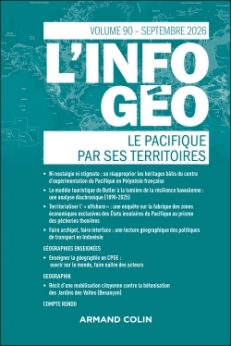
L'information géographique (3/2026)
Le Pacifique par ses territoires
Parution
septembre 2026
EAN
9782200936815
Prix au numéro
15 €
Marque
Armand Colin
Pagination
120 pages
Pour acheter ce numéro, contactez-nous
S'abonner
Recevez les numéros de l'année en cours et accédez à l'intégralité des articles en ligne.
Auteur(s)
Rémi Desmoulière
Faire archipel, faire interface ? Une lecture géographique des politiques de transport en Indonésie
Résumé
Cet article vise à interroger le rapport à la mer de l’Indonésie et son inscription dans l’espace pacifique à partir de l’analyse des grandes politiques de transport conduites par l’État indonésien durant la période de démocratisation de la Reformasi (depuis 1998). L’étude s’intéresse à la fois aux discours et aux représentations qui guident implicitement ou explicitement ces politiques, aux acteurs et aux dispositifs organisationnels qu’elles mobilisent, et à leurs effets spatiaux. Une première partie est consacré aux politiques récentes d’aménagement et de hiérarchisation du système portuaire indonésien, tandis que la seconde examine les politiques de développement et d’encadrement des transports maritimes interinsulaires et leur contribution à l’intégration du Grand Est indonésien. La troisième se concentre sur les grands projets d’infrastructures de transport ferroviaire urbain et interurbain, pour comprendre la place qu’occupe l’Indonésie dans la géopolitique des investissements en Asie-Pacifique.
Mots clés
aménagement
transports
archipel
géopolitique
Indonésie
Asie
Pacifique
Making the archipelago, making the interface ? A geographical reading of transport policies in Indonesia
Abstract
This article investigates Indonesia’s maritime dimension and its relation to the Pacific space through the lens of the main transport policies of the Indonesian state during the period of the Reformasi (since 1998). The study engages with the narratives and representations that underlie these policies, whether implicitly or explicitly, the organizational arrangements and actors who set them in motion, and their spatial effects. The first part deals with the recent policies aimed at planning and structuring port systems and hierarchies, while the second examines development and management policies within the interisland shipping sector, and their contribution to the integration of Eastern Indonesia. The third part focusses on major infrastructure plans for urban and interurban rail transport, in order to understand the role that Indonesia plays within the regional geopolitics of investment in the Asia-Pacific.
Keywords
planning
transport
archipelago
geopolitics
Indonesia
Asia
Pacific
Citation
Rémi Desmoulière, « Faire archipel, faire interface ? Une lecture géographique des politiques de transport en Indonésie », L'information géographique (3/2026), pp. 78-99, Armand Colin. Disponible sur : http://www.revues.armand-colin.com/geographie/linformation-geographique/linformation-geographique-ndeg32026/faire-archipel-faire-interface-lecture-geographique-politiques-transport
DANS LA MÊME thématique
Auteur(s)
Matthieu Schorung
L'information géographique (3/2026)
Le Pacifique par ses territoires
Parution:
septembre 2026
Auteur(s)
Matthieu Schorung
L'information géographique (3/2026)
Le Pacifique par ses territoires
Parution:
septembre 2026