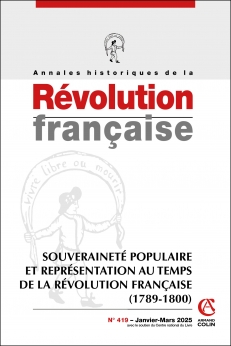
ANNALES HISTORIQUES DE LA RÉVOLUTION FRANÇAISE Nº419 (1/2025)
Souveraineté populaire et représentation au temps de la Révolution française (1789-1800)
Parution
mars 2025
EAN
9782200935948
Prix au numéro
15 €
Marque
Armand Colin
Pagination
216 pages
Pour acheter ce numéro, contactez-nous
S'abonner
Recevez les numéros de l'année en cours et accédez à l'intégralité des articles en ligne.
Auteur(s)
Samuel Hayat
Sovereignty versus politics : the anti-political uses of rousseauism during the revolution
Abstract
Jean-Jacques Rousseau was the subject of a veritable cult during the French Revolution, culminating in his entry into the Pantheon in 1794, precisely when the Thermidorian reaction restricted the rights of popular societies − an illustration of the tension between the celebration of Rousseau and at the same time his defense of the popular sovereignty. This tension, however, is not a contradiction: Rousseau was not an advocate of direct citizen participation in state affairs. His conception of the general will left no place for representation, conflict, or interest; it led to a theory characterized by a certain form of anti-political unanimity in the name of the sovereign people. Such a form of anti-politics was recuperated and adapted by various revolutionaries. It took the form of writings designed to adapt Rousseau’s ideas to the institutional context created by the Revolution, through a revival of representation − though combined with the power of surveillance. It also involved the partisan use of references to Rousseau to delegitimize as factious political opponents accused of usurping the sovereignty of the people. Such borrowings from Rousseau were made variously by the aristocrats against the Assembly, by the Girondins against the Jacobins, by the Jacobins against the moderate parliamentarians, by the Parisian popular movement against the representatives. This rhetoric contributed to the politicization of Rousseauist anti-politics.
Keywords
Rousseauism; popular sovereignty; anti-politics; French Revolution; general will
Citation
Samuel Hayat, « Sovereignty versus politics : the anti-political uses of rousseauism during the revolution », ANNALES HISTORIQUES DE LA RÉVOLUTION FRANÇAISE Nº419 (1/2025), pp. 49-78, Armand Colin. Disponible sur : http://www.revues.armand-colin.com/histoire/annales-historiques-revolution-francaise/annales-historiques-revolution-francaise-no419-12025/sovereignty-versus-politics-the-anti-political
DANS LA MÊME thématique
Auteur(s)
Jean d'Andlau
ANNALES HISTORIQUES DE LA RÉVOLUTION FRANÇAISE Nº419 (1/2025)
Souveraineté populaire et représentation au temps de la Révolution française (1789-1800)
Parution:
mars 2025
Auteur(s)
REVUE DE L'HISTOIRE DES RELIGIONS (4/2024)
Autour de La place de Dieu de Bruno Karsenti
Parution:
décembre 2024